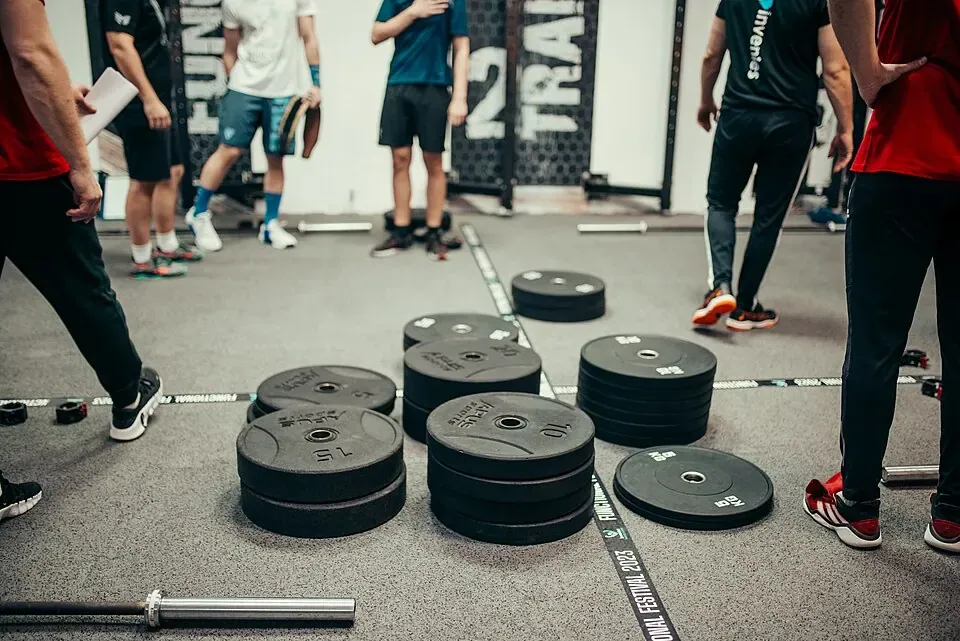
Planned resistance exercise using weights, bands, machines, or bodyweight to load muscles progressively.
At a glance
Evidence: Resistance training reliably improves strength in older-adult trials.Muscle strength from resistance training · Moderate certainty · Randomized intervention
What’s uncertain: Strength gains do not automatically establish less disability or large gains in lean mass.
First step: Start with comfortable resistance and build technique and load gradually.
Before you try it: Reduce loading or complexity if poor sleep impairs your alertness or technique. All precautions
Read the full takeaway
Strength and physical ability
Strength training has an unusual evidence profile: its core effect is large, consistent and randomised, and the claims usually built on top of it are not. Across 121 randomised trials in older adults, progressive resistance training produced a large improvement in measured muscle strength (SMD 0.84, 95% CI 0.67 to 1.00) and only a small improvement in physical ability (SMD 0.14, 95% CI 0.05 to 0.22).
Disability and falls
The same literature found no effect on physical disability or quality of life, and the evidence that resistance training alone prevents falls is uncertain.
Muscle growth
Muscle growth is a separate and weaker claim: the widely quoted gain of about 1.1 kg of lean body mass is a pre-post within-group change from a meta-analysis in which the authors state that no treatment-control effect could be calculated, its heterogeneity is extreme, and a network meta-analysis of 30 randomised trials found no significant lean-mass effect against control at all.
Other health claims
So the defensible statement is that this habit makes you stronger and that being stronger is worth having, while the disease-prevention and body-composition claims attached to it are less well supported than they sound. Prospective cohorts associate muscle-strengthening activity with lower mortality, but that evidence is observational and the retrieved cohorts disagree, and the knee-osteoarthritis result the card previously led on is kept as the specific clinical application it is.
Outcome assessments based on research, including its uncertainties and limitations.
All-cause mortality
Finding: Mixed evidenceCertainty: Limitedstudies disagree, or the effect depends on who is studied
Evidence basis: observational studies (association, not proof of cause)
Observational evidence on strength training and mortality is inconsistent.
Population: Adults aged 18 and over without severe health conditions across 16 prospective cohort studies in the meta-analysis, and 5,855 participants from NHANES 1999-2006 followed through the end of 2019 in the single cohort.
Research details
Summary
The observational evidence disagrees. A systematic review and meta-analysis of sixteen prospective cohorts found muscle-strengthening activities associated with a 10 to 17 percent lower risk of all-cause mortality and of several major diseases, independent of aerobic activity, with a J-shaped dose-response. A separate cohort of 5,855 US adults found no association between meeting resistance-training guidance or training volume and all-cause mortality. The conflict between a synthesis of many cohorts and a single well-characterised cohort remains unresolved.
Why this certainty
Rated Limited because the two evidence streams conflict rather than converge: a sixteen-cohort synthesis reports a protective association while a 5,855-participant cohort reports none. Both are observational, exposure is self-reported, and the J-shaped curve means the association depends on dose in a way a binary comparison obscures. The outcome is directly relevant, but the evidence does not support a confident claim in either direction.
Limitations
All evidence is observational, so confounding by overall health and lifestyle cannot be excluded. Muscle-strengthening activity was self-reported in the NHANES cohort and in most pooled cohorts, which misclassifies exposure. The reported association is J-shaped, so a single hazard ratio cannot summarise the exposure range, and the meta-analysis states that the effect of higher training volumes is unclear. Only about one in ten NHANES participants met the resistance-training guidelines, which limits statistical power.
Effect estimate
Meta-analysis of 16 cohorts: 10 to 17 percent lower risk of all-cause mortality and of cardiovascular disease, total cancer, diabetes and lung cancer with muscle-strengthening activities, with maximum risk reduction of approximately 10 to 20 percent at approximately 30 to 60 minutes per week. NHANES cohort: meeting resistance-training guidelines HR 1.02 (95% CI 0.74 to 1.41) versus not meeting them, and per 1,000 monthly MET-minutes HR 1.02 (95% CI 0.92 to 1.14).
Finding: Benefit supportedCertainty: Limitedstudies found a benefit from doing this
Evidence basis: observational studies (association, not proof of cause)
Strength training is associated with lower diabetes and cardiovascular disease risk.
Population: Adults aged 18 and over without severe health conditions across 16 prospective cohort studies.
Research details
Summary
In the same synthesis of sixteen prospective cohorts, muscle-strengthening activities were associated with lower risk of type 2 diabetes and of cardiovascular disease, and combining muscle-strengthening with aerobic activity was associated with lower mortality than either alone. The diabetes relationship was L-shaped, showing a large risk reduction up to about 60 minutes a week.
Why this certainty
Rated Limited: the direction is consistent within a large synthesis and the dose-response shape is coherent, but the design is observational, exposure is self-reported, and no randomised trial has tested muscle-strengthening activity against diabetes incidence. Relevance is moderate because diabetes incidence is a clinical endpoint rather than a surrogate marker.
Limitations
The evidence is entirely observational and based on self-reported activity, so residual confounding by diet, weight, and socioeconomic position is likely. Several site-specific cancers showed no association, so the pattern is selective rather than general. The synthesis reports associations independent of aerobic activity but cannot fully separate the two behaviours, because people who train with weights often also do aerobic exercise.
Physical function and quality of life in knee osteoarthritis
Finding: Benefit supportedCertainty: Limitedstudies found a benefit from doing this
Evidence basis: randomised trials
A small randomized knee-osteoarthritis trial found better gait speed with progressive strength training; its quality-of-life and BMI results are reported inconsistently.
Population: 56 overweight or obese adults with knee osteoarthritis randomised to a progressive lower-limb resistance-training protocol plus daily-care instructions or to daily-care instructions alone.
Research details
Summary
In a single-centre randomised controlled trial of 56 overweight or obese adults with knee osteoarthritis (mean age 54.6 years, about 64% women), twelve weeks of home-based progressive lower-limb resistance training plus daily-care instructions, compared with daily-care instructions alone, produced significant within-group improvements in gait speed (p <= 0.001), quality of life (p <= 0.001) and body mass index (p = 0.025). The between-group results are reported inconsistently: the paper's abstract gives the quality-of-life difference as p = 0.053, which is not significant, while its results section gives p < 0.001, and the between-group body-mass-index difference was explicitly not significant (p = 0.806), so the body-mass-index reduction is a within-group change only. The control group also improved its quality of life, and the daily-care instruction included caloric-restriction advice. The trial is small and restricted to a clinical population, so the result should not be generalised to healthy adults. This is a clinical application of resistance training rather than a test of the habit in general: it is a single 56-person rehabilitation trial in one symptomatic population, and it is not part of the evidence behind the strength outcome. This is a clinical application of resistance training rather than a test of the habit in general: it is a single 56-person rehabilitation trial in one symptomatic population, and it is not part of the evidence behind the strength outcome.
Why this certainty
Rated Limited: a randomised design supports a causal reading within this population and the trial reports a statistically significant between-group improvement in gait speed together with statistically significant within-group improvements in the other endpoints, but the between-group body-mass-index comparison was null (p = 0.806) and the quality-of-life comparison is reported inconsistently, but the sample is small, blinding is absent, the comparator is inactive, and no independent replication was retrieved. Certainty is further limited because the population is clinical rather than general.
Limitations
This outcome rests on a single small randomised trial of 56 participants, so estimates are imprecise and subgroup findings unreliable. The trial describes itself as single-blinded but does not state who was blinded; participants cannot be blinded to an exercise allocation, and the comparator was usual care, which included caloric-restriction advice, rather than another active exercise programme, so part of the effect may reflect attention or diet rather than resistance training specifically. The paper's own abstract and results section disagree about the between-group quality-of-life difference (p = 0.053 versus p < 0.001), and the between-group body-mass-index comparison was null (p = 0.806), so the BMI change cannot be presented as an advantage over usual care. Outcomes were measured at twelve weeks, so durability is unknown. The trial is small and single-centre, the comparator was daily-care instructions rather than an active intervention, and the paper's own abstract and results disagree about the quality-of-life result, so the specific estimate should not be carried across to other populations or to healthy adults. The trial is small and single-centre, the comparator was daily-care instructions rather than an active intervention, and the paper's own abstract and results disagree about the quality-of-life result, so the specific estimate should not be carried across to other populations or to healthy adults.
Finding: Benefit supportedCertainty: Moderatestudies found a benefit from doing this
Evidence basis: randomised trials
Resistance training reliably increases measured muscle strength in older adults, but the gain does not translate into less disability or fewer falls.
Population: Older and very old adults, mostly aged 60 and over: 6,700 participants across 121 randomised trials in the Cochrane review (mean age in the contributing trials typically in the seventies), 819 healthy older adults with a mean age of 70.4 years in the dose-response analysis of 25 randomised trials, and very elderly adults aged 75 and over across 22 randomised trials. The evidence in healthy younger adults is thinner and less well synthesised in the retrieved literature.
Research details
Summary
Resistance training is one of the few habits in this catalogue whose core effect has been measured in a large randomised base. A Cochrane review of 121 randomised trials with 6,700 participants found a large positive effect on muscle strength (73 trials, 3,059 participants, SMD 0.84, 95% CI 0.67 to 1.00) and a much smaller improvement in physical ability (33 trials, 2,172 participants, SMD 0.14, 95% CI 0.05 to 0.22). A dose-response meta-analysis restricted to resistance training alone in healthy older adults found an even larger strength effect (mean between-subject SMD 1.57 across 25 studies) with small effects on muscle morphology (0.42 across nine studies). In adults aged 75 and over, randomised evidence shows a significant strength effect (difference in effect size 0.97, 95% CI 0.50 to 1.44) and whole-muscle hypertrophy (0.30, 95% CI 0.10 to 0.50), but no significant effect on handgrip strength (0.26, 95% CI -0.02 to 0.54) or muscle fibre hypertrophy (0.33, 95% CI -0.67 to 1.33). What the same literature does not show is that stronger people become less disabled: the earlier Cochrane review found no effect on physical disability or health-related quality of life (10 trials, 798 participants, SMD 0.01, 95% CI -0.14 to 0.16), and a Cochrane review of exercise for falls found the evidence for resistance training alone uncertain (rate ratio 1.14, 95% CI 0.67 to 1.97; very low certainty).
Why this certainty
Rated Moderate. Certainty is not lower because the direction and magnitude are consistent across a Cochrane review of 121 randomised trials, an independent dose-response meta-analysis restricted to resistance training alone, and a randomised synthesis in the very elderly, and because the population and intervention are close to what a reader would actually do. It is not Strong because the largest effect sizes come from a synthesis the authors themselves describe as of poor methodological quality with I2 = 80%, because that same synthesis reports its morphology finding as preliminary on nine studies, because blinding is impossible, because the outcome is a standardised strength measure rather than a functional or clinical endpoint, and because the same literature finds no effect on disability and uncertain effects on falls. The separation between a large strength effect and a small functional one is the single most important thing the evidence says.
Limitations
The effect is real but its quality is limited and it does not transfer to function automatically. The dose-response meta-analysis reports poor overall methodological quality (mean PEDro score 4.6) and considerable heterogeneity for muscle strength (I2 = 80%), and blinding participants to an exercise intervention is impossible, so expectancy contributes. The Cochrane strength effect is measured on a standardised mean difference, which describes the size of a change in standard-deviation units rather than kilograms lifted, and the trials use different devices and protocols, so strength gains are device- and protocol-specific and do not necessarily represent everyday capability. The population is predominantly older adults, and the two most-quoted summary figures in this area come from analyses of older adults, so the entry does not extend them to younger healthy adults. Adverse events were poorly collected and reported across this literature, which limits what can be said about safety as much as about benefit.
Effect estimate
Muscle strength: SMD 0.84 (95% CI 0.67 to 1.00; 73 trials, 3,059 participants) in older adults, and mean between-subject SMD 1.57 (25 studies) in healthy older adults restricted to resistance training alone. Physical ability: SMD 0.14 (95% CI 0.05 to 0.22; 33 trials, 2,172 participants). Physical disability and quality of life: SMD 0.01 (95% CI -0.14 to 0.16; 10 trials, 798 participants). Falls with resistance training alone: rate ratio 1.14 (95% CI 0.67 to 1.97; 5 studies, 327 participants; very low certainty).
Lean mass and body composition from resistance training
Finding: Mixed evidenceCertainty: Limitedstudies disagree, or the effect depends on who is studied
Evidence basis: randomised trials
The widely quoted one-kilogram lean-mass gain is a pre-post change with no control comparison, and the best-controlled synthesis found no effect at all.
Population: Adults aged 50 and over in the meta-analysis of 49 studies and 81 cohorts (1,328 participants), healthy older adults with a mean age of 70.4 years across 25 randomised trials, adults aged 75 and over across 22 randomised trials, and 1,405 participants across 30 randomised trials in the network meta-analysis.
Research details
Summary
Resistance training is usually described as building muscle, and the retrieved evidence does not support that as firmly as the claim implies. The most-cited figure comes from a meta-analysis of 49 studies and 1,328 adults aged 50 and over, which pooled a weighted mean lean body mass change of 1.1 kg (95% CI 0.9 to 1.2) using random-effects models - but every one of those studies measured a pre-post change within its own participants, so the figure includes growth from any cause and has no control group to subtract. Against that, a network meta-analysis of 30 randomised controlled trials with 1,405 participants aged 60 and over found that no exercise intervention it examined had a significant effect on lean body mass, and it reports a controlled resistance-training effect where one exists: 12.8 kg greater strength improvement than usual care (95% CI 8.5 to 17.0 kg). The trials that measure hypertrophy under controlled conditions find a small effect: in adults aged 75 and over, whole-muscle hypertrophy differed from control by an effect size of 0.30 (95% CI 0.10 to 0.50) while muscle fibre hypertrophy did not differ at all (0.33, 95% CI -0.67 to 1.33). The dose-response analysis restricted to resistance training alone found small effects on muscle morphology (mean between-subject SMD 0.42 across nine studies), reported the finding as preliminary on nine studies, and found that no training volume variable significantly predicted it. The honest summary is that resistance training makes people stronger much more reliably than it makes their muscles visibly bigger, and that the single most quoted number for muscle growth is not a controlled effect. Separate adjunct studies suggest small additional gains with protein supplementation and possible attenuation of hypertrophy with immediate post-training cold-water immersion; they are not the same comparison as resistance training alone.
Why this certainty
Rated Limited and recorded as Mixed evidence rather than as a benefit, because the direction of the best-controlled evidence is null while the largest single figure is uncontrolled. It is not Little/no effect, because controlled trials measuring muscle directly do find a small positive effect in the very old, and because the null result comes from one synthesis rather than several. It is not Moderate, because the most-quoted estimate cannot support a treatment effect, because heterogeneity in that analysis is extreme, because measurement methods are inconsistent across trials, and because no retrieved synthesis controls for the protein and energy intake that determines the outcome. This is deliberately a separate outcome from strength: the evidence for one is not evidence for the other, and the entry would mislead a reader by combining them.
Limitations
The measurement method changes the answer, which is the central problem. Lean body mass estimated from a whole-body scan includes water, glycogen and connective tissue as well as muscle, so a change in it is not the same as muscle hypertrophy, and the trials that measured muscle directly found smaller or absent effects. Only 37 percent of the studies in the +1.1 kg meta-analysis were randomised, its heterogeneity was extreme (Q = 497.8, I2 = 84%), and its pooled estimate is a within-group pre-post change with no control arm, so it cannot separate training from measurement drift, fluid shifts or the natural history of the population. The controlled synthesis that can make that comparison found no significant effect of any exercise intervention on lean body mass across 30 trials. The resistance-training-alone dose-response analysis calls its own morphology finding preliminary because only nine studies contributed, and found no training variable that predicted it. Trials are short relative to the timescale of muscle growth, and diet was not controlled in most of them, so protein intake and energy balance - both of which determine whether training adds muscle - vary between participants and are rarely reported. The protein and cold-immersion studies concern modifiers of training, not proof of a special meal order or an established safe delay before cold exposure. Cold-immersion studies were few and of fair-to-poor quality.
Effect estimate
Lean body mass, pre-post within-group change with no control comparison: +1.1 kg (95% CI 0.9 to 1.2) in 1,328 adults aged 50 and over across 49 studies, with heterogeneity Q = 497.8 and I2 = 84%. Controlled comparison: no significant effect of resistance training, endurance training or whole-body vibration on lean body mass across 30 randomised trials and 1,405 participants aged 60 and over. Resistance training versus usual care in the same network meta-analysis: muscle strength 12.8 kg greater improvement (95% CI 8.5 to 17.0 kg). In adults aged 75 and over: whole-muscle hypertrophy difference in effect size 0.30 (95% CI 0.10 to 0.50), muscle fibre hypertrophy 0.33 (95% CI -0.67 to 1.33, not significant).
Train the major muscle groups about twice a week, the frequency that physical-activity guidance and the cohort evidence converge on.
Treat roughly 30 to 60 minutes a week of muscle-strengthening activity as an editorial starting point; the cohort data showed the largest risk reductions in that band, with a J-shaped curve above it.
Choose exercises and progression for your goal: strength, muscle size and power are related but distinct. Progress the load gradually and prioritise consistent technique; fast-intended power work has its own entry and does not require rushing every repetition.
If you are new to resistance training, start with bodyweight or elastic-band work before loading heavily. Review adequate total protein across the day, and if muscle growth is the priority, avoid making immediate post-lifting cold-water immersion a routine recovery step.
Precautions
Injuries occur with heavy or unfamiliar loading; introduce new movements with light resistance and consider supervised coaching at the start.
General safety guidance rather than a finding from the cited trials: seek medical advice before starting if you have uncontrolled blood pressure, a recent musculoskeletal injury, or a cardiovascular condition, because straining raises blood pressure acutely.
Stop and seek assessment if joint pain persists beyond the session rather than settling.
After poor sleep, reduce load or choose simpler comfortable movement when alertness or technique is impaired. Do not use training as a substitute for adequate sleep.
References
Muscle-strengthening activities are associated with lower risk and mortality in major non-communicable diseases: a systematic review and meta-analysis of cohort studies
Momma H, Kawakami R, Honda T, Sawada SS · British Journal of Sports Medicine · 2022
Systematic review and meta-analysis of prospective cohort studies (16 studies)Verified from abstract
Effect of Progressive Resistance Strength Training on Body Mass Index, Quality of Life and Functional Capacity in Knee Osteoarthritis: A Randomized Controlled Trial
Rafiq MT, A Hamid MS, Hafiz E · Journal of Multidisciplinary Healthcare · 2021
Randomized controlled trial of a twelve-week home-based progressive resistance training protocolVerified from abstract
Dose-Response Relationships of Resistance Training in Healthy Old Adults: A Systematic Review and Meta-Analysis.
Borde R, Hortobágyi T, Granacher U · Sports medicine (Auckland, N.Z.) · 2015
Systematic review and meta-analysis of randomised controlled trials in healthy older adults, restricted to resistance training alone with concurrent training and nutritional supplements excluded. Facts are quoted from the retrieved abstract; the meta-regression result for muscle morphology and the strength-versus-size comparison in this paper's discussion were read in a research report rather than in a retrieved document and are not stored here.Verified from abstract
Effects of Resistance Training on Muscle Size and Strength in Very Elderly Adults: A Systematic Review and Meta-Analysis of Randomized Controlled Trials.
Grgic J, Garofolini A, Orazem J, Sabol F, Schoenfeld BJ, Pedisic Z · Sports medicine (Auckland, N.Z.) · 2020
Systematic review and meta-analysis of randomised controlled trials in adults aged 75 and overVerified from abstract
Progressive resistance strength training for physical disability in older people.
Latham N, Anderson C, Bennett D, Stretton C · The Cochrane database of systematic reviews · 2003
Cochrane systematic review and meta-analysis of randomised controlled trials (superseded by the 2009 update under the same review number)Verified from abstract
Exercise for preventing falls in older people living in the community.
Sherrington C, Fairhall NJ, Wallbank GK, Tiedemann A, Michaleff ZA, Howard K, Clemson L, Hopewell S, Lamb SE · The Cochrane database of systematic reviews · 2019
Cochrane systematic review and meta-analysis of 108 randomised controlled trials with 23,407 community-dwelling participants aged 60 and over, with GRADE assessment. Facts are quoted from the retrieved abstract. Full-text accessibility rechecked on 2026-10-04: Europe PMC lists the record as not open access; the NCBI XML response explicitly says the publisher does not allow downloading the full text, and publisher/PMC HTML could not be retrieved. This record remains abstract-checked.Verified from abstract
World Health Organization 2020 guidelines on physical activity and sedentary behaviour.
Bull FC, Al-Ansari SS, Biddle S, Borodulin K, Buman MP, Cardon G, Carty C, Chaput JP, Chastin S, Chou R, Dempsey PC, DiPietro L, Ekelund U, Firth J, Friedenreich CM, Garcia L, Gichu M, Jago R, Katzmarzyk PT, Lambert E, Leitzmann M, Milton K, Ortega FB, Ranasinghe C, Stamatakis E, Tiedemann A, Troiano RP, van der Ploeg HP, Wari V, Willumsen JF · British journal of sports medicine · 2020
WHO guideline development process with systematic reviews of evidence and GRADE assessment, published as a summary in the British Journal of Sports Medicine. Facts are quoted from the retrieved abstract. The guideline recommendations themselves are published in the guidelines document, which was not retrieved, so this record stores only what the abstract states.Verified from abstract
Influence of resistance exercise on lean body mass in aging adults: a meta-analysis.
Peterson MD, Sen A, Gordon PM · Medicine and science in sports and exercise · 2011
Meta-analysis of 49 studies and 81 cohorts, 1,328 participants aged 50 and over, pooling pre-post within-group change rather than a treatment-control effect. Facts are quoted from the retrieved abstract.Verified from abstract
Effects of resistance training, endurance training and whole-body vibration on lean body mass, muscle strength and physical performance in older people: a systematic review and network meta-analysis.
Lai CC, Tu YK, Wang TG, Huang YT, Chien KL · Age and ageing · 2018
Systematic review and network meta-analysis of randomised controlled trials in adults aged 60 and over, comparing resistance training, endurance training and whole-body vibration against each other and against usual care. Facts are quoted from the retrieved abstract.Verified from abstract
A systematic review, meta-analysis and meta-regression of the effect of protein supplementation on resistance training-induced gains in muscle mass and strength in healthy adults.
Morton RW, Murphy KT, McKellar SR, Schoenfeld BJ, Henselmans M, Helms E, Aragon AA, Devries MC, Banfield L, Krieger JW, Phillips SM. · British journal of sports medicine · 2018
Systematic reviewSystematic review, meta-analysis and meta-regression of 49 randomized resistance-training trialsVerified from full text
Throwing cold water on muscle growth: A systematic review with meta‐analysis of the effects of postexercise cold water immersion on resistance training‐induced hypertrophy
Piñero A, Burke R, Augustin F, Mohan AE, DeJesus K, Sapuppo M, Weisenthal M, Coleman M, Androulakis-Korakakis P, Grgic J, Swinton PA, Schoenfeld BJ. · European journal of sport science · 2024
Systematic reviewSystematic review and meta-analysis of eight post-resistance-training cold-water-immersion studiesVerified from full text
Revision 9 · Approved for publication · Codex (publication approval explicitly authorized by site owner; category migration)
Prepared and checked with AI. Publication approval does not imply independent expert review. Request a correction.
Revision 4, applying the high-risk audit corrections (_report-focus-b.md). Changes: (1) the physical-function outcome summary no longer claims that twelve weeks of resistance training improved functional capacity and quality of life and reduced BMI "compared with usual care" - it now separates what the trial measured within groups (gait speed p <= 0.001, quality of life p <= 0.001, BMI p = 0.025) from what it reported between groups, which is a non-significant BMI difference (p = 0.806) and an internally inconsistent quality-of-life difference (p = 0.053 in the abstract versus p < 0.001 in the results section). The control group's own quality-of-life improvement and the caloric-restriction component of the daily-care instruction are stated. (2) The limitations no longer say participants were not blinded: the trial describes itself as single-blinded without stating who was blinded, and this is now recorded alongside the comparator and the reporting inconsistency. (3) The certainty rationale states the between-group picture rather than only the within-group improvements. (4) The medical-clearance precaution is labelled general safety guidance rather than evidence-based content, since no cited source supports it. (5) The between-group values were appended to rafiq-2021-prst-knee-oa so the new claims are traceable; that record's accessLevel is still "abstract" although the audit read the full text.
A second reviewer must re-check: (a) which of the two reported quality-of-life p-values is correct cannot be resolved from the paper - the entry now reports both and says they conflict; (b) whether the rafiq-2021-prst-knee-oa record should be promoted to full_text with the PMC8364840 URL; (c) the audit notes the entry has no outcome for the habit's core established effect (muscle strength and lean mass in healthy adults) and that adding one is an editorial decision - not done here. Structural pass: the entry now has an outcome for the effect the habit is actually named after. Two outcomes were added - `muscle-strength-gains` (Benefit supported, Moderate, randomised: SMD 0.84 across 73 trials for strength against SMD 0.14 for physical ability, plus the null disability and uncertain falls results) and `lean-mass-and-body-composition` (Mixed evidence, Limited, because the +1.1 kg figure the internet quotes is a pre-post within-group change with no control comparison while the best-controlled network meta-analysis of 30 randomised trials found no lean-mass difference). The default card is now `muscle-strength-gains`, so a habit called Strength training no longer leads on a 56-person knee-osteoarthritis rehabilitation trial, which is retained as a clinical application. The verdict and card summary state the dissociation between strength and function explicitly, and the diet-and-exercise question is handled by keeping only resistance-training-alone syntheses on the strength and mass outcomes - the knee-osteoarthritis trial is the only combined-protocol source and its limitations say the comparator was usual care.
Second reviewer must check: (a) whether Moderate is right for strength given that the largest effect estimate comes from a synthesis its own authors call poor quality with I2 = 80%; (b) whether the entry should name healthy younger adults anywhere, since almost all of this evidence is in older adults; (c) whether the AHA statement on resistance exercise in cardiovascular disease should be retrieved in full before any contraindication is stated, which this pass did not do.
Second source-repair round: this entry cited Borde 2015 for a comparison between the decline in muscle strength and the decline in muscle size, and that sentence is in the paper's discussion rather than its abstract, which is the only part retrieved here. The sentence is removed rather than attributed to a document nobody read, and the lean-mass outcome now uses the controlled network meta-analysis figure (no significant effect of any exercise intervention on lean body mass across 30 trials, with resistance training giving 12.8 kg greater strength improvement than usual care) alongside the pre-post 1.1 kg estimate the internet quotes.
October 3 video follow-up: Added protein-total and immediate post-training cold-immersion context to the lean-mass assessment and practical guidance. Kept training-alone estimates separate. Verify that no exact safe waiting period or benefit from every recovery method is implied.
October 3 training follow-up: Distinguished strength, hypertrophy and power without importing a new longevity claim. Independent editorial approval remains pending. Publication release 2026-10-04: site owner authorized a bounded AI audit and release of this exact revision. See docs/release-audit-2026-10-04.md for source-check findings and limits. No independent health-professional or peer review is claimed.
Category migration 2026-10-04: removed the separate goals field; categories: Exercise, Long-term health → Exercise, Long-term health. Research assessments, sources, guidance, precautions, and evidence review dates are unchanged. This revision awaits publication approval; no new evidence review is claimed.
Publication approval 2026-10-04: site owner explicitly accepted all current category-migration revisions for deployment and requested that remaining limitations be retained in docs/content-review-backlog.md. Approval applies to this exact content revision. No new evidence review, independent expert review, or clinical validation is claimed; existing precautions and disclosures remain in effect.