Skip to content
Back to results

Soluble fibre for LDL cholesterol

Viscous soluble fibre from oats, barley and psyllium, eaten regularly with the aim of lowering LDL cholesterol.

At a glance

  • Evidence: Soluble, viscous fibre from oats, barley and psyllium lowers LDL cholesterol across several independent meta-analyses of randomized trials, which draw on overlapping sets of the same trials.LDL cholesterol reduction · Strong certainty · Randomized intervention
  • What’s uncertain: Most contributing trials were small and short (2-12 weeks), so long-term LDL and clinical-outcome effects are not established.
  • First step: Pick a real food form you will actually eat regularly: oat porridge or oat bran, barley in soups, stews or as a side grain, or psyllium husk stirred into water or yoghurt.
  • Before you try it: The FDA regulation requires foods containing psyllium husk to meet the additional labelling provisions in 21 CFR 101.17(f); follow the product label's directions, including taking psyllium with enough fluid. All precautions

Takeaway

Regular soluble fibre from oats, barley or psyllium lowers LDL cholesterol, and the US FDA regulation 21 CFR 101.81 names 3 g or more per day of beta-glucan from whole oats or barley and 7 g or more per day of psyllium husk soluble fibre as intakes associated with reduced coronary heart disease risk. Those pooled LDL reductions come from short trials, so a long-term clinical benefit is not established.

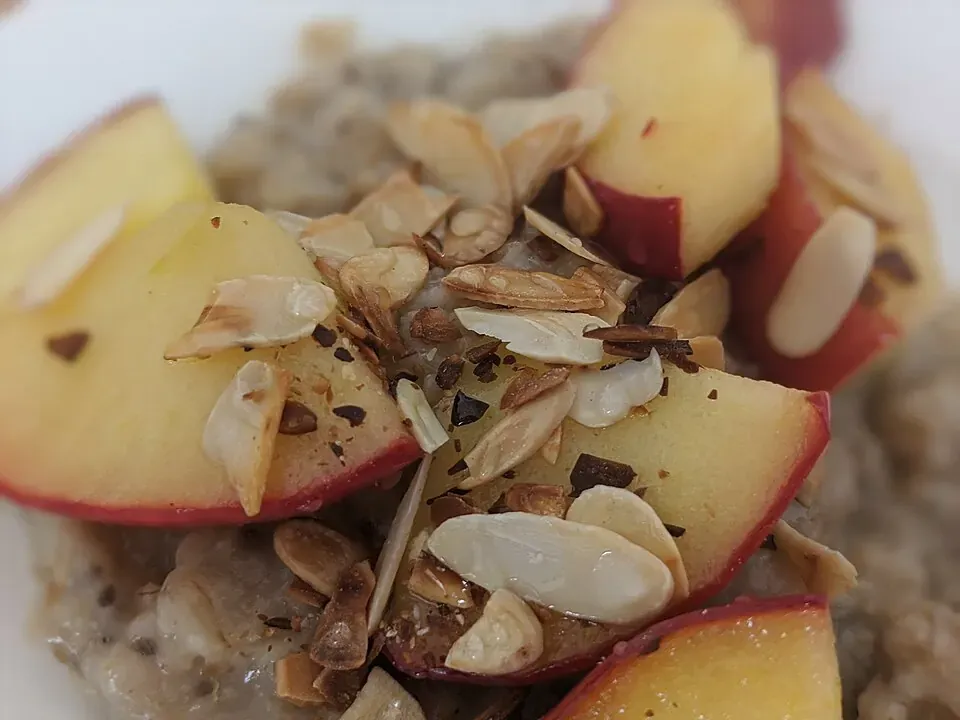
A bowl of oatmeal with apple
NutritionLong-term healthUnder 10 min · Easy · Low
Reviewed Sep 23, 2026
Save

Scientific evidence

What the research shows

Outcome assessments based on research, including its uncertainties and limitations.

LDL cholesterol reduction

Finding: Benefit supportedCertainty: Strongstudies found a benefit from doing this

Evidence basis: randomised trials

Soluble, viscous fibre from oats, barley and psyllium lowers LDL cholesterol across several independent meta-analyses of randomized trials, which draw on overlapping sets of the same trials.

Population: Adults with and without hypercholesterolaemia, including some participants with type 2 diabetes, enrolled in randomized controlled trials; individual trials ranged from about 2 to 12 weeks in duration, and the FDA health claim applies to the general population eating a diet low in saturated fat and cholesterol.

Research details

Summary

Soluble, viscous fibre from oats, barley and psyllium lowers LDL cholesterol, and the effect has been reproduced in several meta-analyses of randomized trials, although they draw on overlapping sets of the same trials. Oat beta-glucan at 3 g/day or more reduced LDL cholesterol by 0.25 mmol/L (95% CI 0.20, 0.30), a median 3.5 g/day of oat beta-glucan by 0.19 mmol/L (95% CI -0.23, -0.14), a median 6.5 g/day of barley beta-glucan by 0.25 mmol/L (95% CI -0.30, -0.20), and a median about 10.2 g/day of psyllium by 0.33 mmol/L (95% CI -0.38, -0.27). LDL lowering was significantly greater in people with higher baseline LDL cholesterol and in people with diabetes (the latter based on few studies), so the average effect overstates the benefit for someone starting from a low LDL. The US FDA authorizes a coronary heart disease health claim at 3 g/day or more of beta-glucan from whole oats or barley and 7 g/day or more of psyllium soluble fibre.

Why this certainty

Rated Strong because the direction and statistical robustness of LDL cholesterol lowering are reproducible across independent systematic reviews of randomized trials, across three different fibre sources, and across regulatory assessments, with an authorised FDA health claim specifying minimum effective daily intakes. Certainty is not downgraded for the surrogate nature of the outcome, which is the accepted regulatory basis for the claim. It is held below absolute because pooled magnitudes are heterogeneous and most trials are short and small, so the precise size of benefit for an individual remains uncertain.

Limitations

Most contributing trials were small and short (2-12 weeks), so long-term LDL and clinical-outcome effects are not established. Statistical heterogeneity was substantial and largely unexplained in several pooled analyses (I2 = 79% for LDL cholesterol with oat beta-glucan; I2 = 99% for non-HDL cholesterol), implying the size of the effect varies between products and populations even though its direction is consistent. GRADE assessment in the psyllium review rated LDL cholesterol evidence as only moderate quality because of inconsistency, and regulatory claims attach to specific food sources and daily doses rather than to soluble fibre in general.

Effect estimate

Oat beta-glucan >=3 g/d: LDL cholesterol -0.25 mmol/L (95% CI 0.20, 0.30; P < 0.0001) (Whitehead 2014). Oat beta-glucan median 3.5 g/d: LDL cholesterol -0.19 mmol/L (95% CI -0.23, -0.14; P<0.00001) (Ho 2016). Barley beta-glucan median 6.5 g/d: LDL cholesterol -0.25 mmol/L (95% CI -0.30, -0.20) (Ho 2016). Psyllium median about 10.2 g/d: LDL cholesterol -0.33 mmol/L (95% CI -0.38, -0.27; P < 0.00001) (Jovanovski 2018). Whitehead 2014 reported heterogeneity P = 0.13 for the LDL analysis and P = 0.067 for the total-cholesterol analysis.

Total cholesterol, non-HDL cholesterol and apolipoprotein B

Finding: Benefit supportedCertainty: Moderatestudies found a benefit from doing this

Evidence basis: randomised trials

The same soluble fibres lower total cholesterol and the broader atherogenic cholesterol burden.

Population: Adults with or without hypercholesterolaemia in randomized controlled trials: 28 trials for oat beta-glucan (Whitehead 2014), 58 trials (n = 3974) for oat beta-glucan, 14 trials (N = 615) for barley beta-glucan, 28 trials (n = 1924) for psyllium, and 28 blinded trials totalling 1494 subjects for whole oats versus isolated beta-glucan.

Research details

Summary

The same soluble fibres lower total cholesterol and the broader atherogenic cholesterol burden. Oat beta-glucan at 3 g/day or more reduced total cholesterol by 0.30 mmol/L (95% CI 0.24, 0.35; P < 0.0001), and a meta-analysis of blinded oat and beta-glucan trials reported standardized mean differences of about -0.61 to -0.73 for total cholesterol. Non-HDL cholesterol fell by 0.20 mmol/L (95% CI -0.26, -0.15) with oat beta-glucan and 0.31 mmol/L (95% CI -0.39, -0.23) with barley beta-glucan, and psyllium reduced apolipoprotein B by 0.05 g/L (95% CI -0.08, -0.03). The FDA claim explicitly links these fibres to lower blood total- and LDL-cholesterol.

Why this certainty

Rated Moderate: multiple randomized-trial syntheses agree on direction for total and non-HDL cholesterol, psyllium apolipoprotein B was graded high quality by GRADE, and FDA authorises a claim referencing blood total- and LDL-cholesterol. Downgrades reflect very high unexplained heterogeneity for non-HDL cholesterol, inconsistent apolipoprotein B results between barley and psyllium, reliance on short small trials, and the use of standardized rather than absolute units in one meta-analysis, which limits confidence in the exact effect size.

Limitations

The pooled estimates come from different fibre sources, doses and comparators, with medians of 3.5 g/day (oat), 6.5-6.9 g/day (barley) and about 10.2 g/day (psyllium), so the numbers are not interchangeable. Barley beta-glucan did not significantly change apolipoprotein B, and the barley apolipoprotein B finding contrasts with the psyllium result. Heterogeneity for non-HDL cholesterol was very high (I2 = 98% for barley; I2 = 99% for oat). The 2023 oat/beta-glucan meta-analysis reports standardized mean differences rather than mmol/L, so its magnitudes cannot be compared directly with the mmol/L estimates.

Effect estimate

Oat beta-glucan >=3 g/d: total cholesterol -0.30 mmol/L (95% CI 0.24, 0.35; P < 0.0001) (Whitehead 2014). Non-HDL cholesterol -0.20 mmol/L (95% CI -0.26, -0.15; P<0.00001) with oat beta-glucan median 3.5 g/d and -0.31 mmol/L (95% CI -0.39, -0.23) with barley beta-glucan median 6.9 g/d (Ho 2016). Psyllium median about 10.2 g/d: non-HDL cholesterol -0.39 mmol/L (95% CI -0.50, -0.27; P < 0.00001) and apolipoprotein B -0.05 g/L (95% CI -0.08, -0.03; P < 0.0001) (Jovanovski 2018). Isolated beta-glucan, parallel-arm trials: total cholesterol SMD -0.73 (95% CI -1.01 to -0.45) (de Morais Junior 2023, standardized mean difference).

HDL cholesterol and triglycerides

Finding: Mixed evidenceCertainty: Moderatestudies disagree, or the effect depends on who is studied

Evidence basis: randomised trials

Oat and beta-glucan interventions do not raise HDL cholesterol, and the triglyceride picture is inconsistent; the psyllium and barley reviews retrieved here did not report HDL or triglyceride outcomes.

Population: Adults in randomized controlled trials of oats or isolated beta-glucan: 28 trials in the oat beta-glucan meta-analysis (doses 3.0-12.4 g/d, durations 2-12 weeks) and 28 blinded parallel-arm or crossover trials totalling 1494 subjects in the whole-oat versus isolated beta-glucan meta-analysis.

Research details

Summary

The oat and beta-glucan interventions tested do not raise HDL cholesterol, and the triglyceride picture is inconsistent; the psyllium and barley reviews retrieved here report no HDL or triglyceride outcome at all. Two independent meta-analyses agree that HDL cholesterol is unchanged: the oat beta-glucan meta-analysis found no significant effect on HDL cholesterol or triglycerides, and the whole-oat versus isolated beta-glucan meta-analysis stated that HDL was not altered by either oat or isolated beta-glucan (p > 0.05). Triglycerides were not significantly changed by 3 g/day or more of oat beta-glucan, but isolated beta-glucan from parallel-arm trials reduced triglycerides (standardized mean difference -0.30, 95% CI -0.49 to -0.12).

Why this certainty

Rated Moderate for the outcome as a whole: the null HDL finding is consistent across two independent syntheses with adequate sample size and is therefore reasonably secure, but the triglyceride findings conflict between reviews and derive from short trials and a subgroup analysis. Because one component is consistently null and the other is inconsistent, a single benefit finding is not supportable, so the outcome is recorded as Mixed/uncertain rather than as a benefit.

Limitations

Only two meta-analyses inform this outcome, and the triglyceride signal comes from a subgroup of parallel-arm isolated-beta-glucan trials in a single review rather than from a consistent body of evidence; that review reported standardized mean differences, so the absolute triglyceride change in mmol/L is not known from the retrieved text. The oat beta-glucan meta-analysis covered only 2-12 week durations, so nothing can be said about longer-term HDL or triglyceride effects, and the psyllium and barley reviews did not report HDL or triglyceride outcomes in the abstracts retrieved.

Effect estimate

No significant effect of oat beta-glucan >=3 g/d on HDL cholesterol or triglycerides (Whitehead 2014). HDL was not altered by either oat or isolated beta-glucan (p > 0.05) (de Morais Junior 2023). Isolated beta-glucan, parallel-arm trials: triglycerides SMD -0.30 (95% CI -0.49; -0.12, p = 0.001) (de Morais Junior 2023, standardized mean difference).

What people say

Who discusses this?

Public statements, with positions specific to each source and topic. These views do not determine the scientific evidence assessment.

What the research shows ↑

No sourced public statements added for this habit yet. This does not mean no one discusses it.

Practical steps and precautions

How to try it

  1. Pick a real food form you will actually eat regularly: oat porridge or oat bran, barley in soups, stews or as a side grain, or psyllium husk stirred into water or yoghurt.
  2. If you want a target, treat 3 g or more per day of beta-glucan from whole oats or barley, and 7 g or more per day of psyllium husk soluble fibre, as the intakes named in the US FDA regulation 21 CFR 101.81 rather than as a personal prescription.
  3. Increase fibre gradually and keep fluid intake adequate, since a sudden large increase is poorly tolerated by the gut.
  4. Keep outcome expectations separate: the pooled LDL reductions come from trials lasting roughly 2 to 12 weeks, so whether this lowers heart attacks or deaths over years is not established.

Precautions

  • The FDA regulation requires foods containing psyllium husk to meet the additional labelling provisions in 21 CFR 101.17(f); follow the product label's directions, including taking psyllium with enough fluid.
  • Soluble fibre added quickly can cause bloating, gas and looser stools; build up gradually rather than starting at a full daily target.
  • This is not a substitute for prescribed lipid-lowering treatment; the trials tested soluble fibre within usual diets rather than instead of medication.

References

Cholesterol-lowering effects of oat beta-glucan: a meta-analysis of randomized controlled trials.

Whitehead A, Beck EJ, Tosh S, Wolever TMS · The American Journal of Clinical Nutrition · 2014

Meta-analysis of randomized controlled trialsVerified from abstract
Open original source

The effect of oat beta-glucan on LDL-cholesterol, non-HDL-cholesterol and apoB for CVD risk reduction: a systematic review and meta-analysis of randomised-controlled trials.

Ho HVT, Sievenpiper JL, Zurbau A, Blanco Mejia S, Jovanovski E, Au-Yeung F, et al. · British Journal of Nutrition · 2016

Systematic review and meta-analysis of randomized controlled trialsVerified from abstract
Open original source

A systematic review and meta-analysis of randomized controlled trials of the effect of barley beta-glucan on LDL-C, non-HDL-C and apoB for cardiovascular disease risk reduction.

Ho HVT, Sievenpiper JL, Zurbau A, Blanco Mejia S, Jovanovski E, Au-Yeung F, et al. · European Journal of Clinical Nutrition · 2016

Systematic review and meta-analysis of randomized controlled trialsVerified from abstract
Open original source

Effect of psyllium (Plantago ovata) fiber on LDL cholesterol and alternative lipid targets, non-HDL cholesterol and apolipoprotein B: a systematic review and meta-analysis of randomized controlled trials.

Jovanovski E, Yashpal S, Komishon A, Zurbau A, Blanco Mejia S, Ho HVT, et al. · The American Journal of Clinical Nutrition · 2018

Systematic review and meta-analysis of randomized controlled trials with GRADE assessmentVerified from abstract
Open original source

The separate effects of whole oats and isolated beta-glucan on lipid profile: A systematic review and meta-analysis of randomized controlled trials.

de Morais Junior AC, Schincaglia RM, Viana RB, Armet AM, Prado CM, Walter J, Mota JF · Clinical Nutrition ESPEN · 2023

Systematic review and meta-analysis of blinded randomized controlled trialsVerified from abstract
Open original source

21 CFR 101.81 - Health claims: Soluble fiber from certain foods and risk of coronary heart disease (CHD).

US Food and Drug Administration · US Food and Drug Administration (Code of Federal Regulations) · 2023

Government reportRegulatory health-claim authorization with eligibility criteria and model claim wording (US Code of Federal Regulations)Verified from full text
Open original source

Community

Discussion

Have you tried this? What helped or made it difficult?

Reader experiences are separate from the scientific evidence. Explore all discussions

No discussions yet.

Be the first to ask a question or share your experience.

Sign in to vote or join the discussion.

Explore other habits in a shared category. Each has its own evidence and precautions.

Editorial history and review method

Revision 5 · Approved for publication · HabitSeek site owner (publication approval); Codex discovery audit

Prepared and checked with AI. Publication approval does not imply independent expert review. Request a correction.

Applied the audit corrections for soluble-fibre-cholesterol. (1) The HDL/triglyceride outcome generalised from oat and beta-glucan to 'soluble fibre' in both its headline and its summary first sentence, although the psyllium and barley reviews retrieved report no HDL or triglyceride outcome; both are now scoped to the interventions that were actually tested. (2) Removed the claim that the LDL effect has been reproduced across 'more than 100 trials in total' from the card headline and the LDL summary: the five syntheses are not independent (Whitehead's 28 oat trials sit inside the 58 that Ho 2016 pooled, and de Morais 2023 draws on 28 of the same studies), so the count cannot be read as distinct trials. (3) Added the effect modifiers Whitehead 2014 reports, which the verdict previously omitted: LDL lowering was significantly greater with higher baseline LDL cholesterol and in people with diabetes, so the average effect overstates the benefit for someone starting from a low LDL. (4) Moved the stray Whitehead heterogeneity statistics (P = 0.13 for LDL, P = 0.067 for total cholesterol) out of the HDL/triglyceride effect estimate and into the LDL outcome, where they belong. (5) Completed the stored cardSummary truncation, which ended mid-word at 'psylliu…'. Second reviewer must re-check: (a) the Ho 2016 barley erratum (Eur J Clin Nutr 2016;70(11):1340, doi 10.1038/ejcn.2016.129) is indexed without an abstract, so the corrected barley estimates could not be checked and the quoted barley LDL and non-HDL values may have been revised; (b) the EFSA opinion on beta-glucans from oats and barley remains unretrieved (publisher returned HTTP 403) and is deliberately excluded; (c) whether a surrogate outcome with a regulatory claim should carry Strong certainty in a catalogue that records other shifted physiological markers as Indirect evidence - this remains an editorial question and was left as the entry justified it. Publication release 2026-10-04: site owner authorized a bounded AI audit and release of this exact revision. See docs/release-audit-2026-10-04.md for source-check findings and limits. No independent health-professional or peer review is claimed. Category migration 2026-10-04: removed the separate goals field; categories: Nutrition, Long-term health → Nutrition, Long-term health. Research assessments, sources, guidance, precautions, and evidence review dates are unchanged. This revision awaits publication approval; no new evidence review is claimed. Publication approval 2026-10-04: site owner explicitly accepted all current category-migration revisions for deployment and requested that remaining limitations be retained in docs/content-review-backlog.md. Approval applies to this exact content revision. No new evidence review, independent expert review, or clinical validation is claimed; existing precautions and disclosures remain in effect. Discovery audit 2026-10-10: added familiar search aliases. Outcome assessments, evidence sources, practical guidance, precautions and evidence-review date are unchanged. Formulation aliases identify the topic covered, not an endorsement or a new effectiveness claim. This exact revision awaits publication approval. Publication approval 2026-10-10: site owner answered 'Approve and publish' to the question explicitly covering these eight naming/search revisions and deployment to habitseek.com. Approval applies to this exact revision. Evidence assessments, guidance, precautions and scientific review dates were unchanged by the discovery audit. This is publication approval, not independent expert or clinical validation. The 15 later supplement drafts are outside this approval.