Skip to content
Back to results

Weighted blankets

A heavy quilted blanket, usually filled with glass or plastic beads, used in bed for the sensation of deep pressure.

At a glance

  • Evidence: Randomised trials agree that weighted blankets are well tolerated and disagree completely about sleep, because each tested a different population.Sleep outcomes in the populations that have been randomised · Limited certainty · Randomized intervention
  • What’s uncertain: Adult psychiatric, autistic-child and ADHD-child trials measure different outcomes; they do not establish a general benefit for healthy adults.
  • First step: Choose a weight that still lets you move, turn over, and breathe comfortably.
  • Before you try it: Do not use a weighted blanket with an infant, a small child, or anyone who cannot remove it independently. All precautions
Read the full takeaway

What was studied

Weighted blankets have been tested in randomised trials, and the trials do not agree - because they studied different people.

Sleep results by population

In 120 adults with major depression, bipolar disorder, generalised anxiety disorder or ADHD and insomnia, a weighted chain blanket beat a light blanket on insomnia severity by a large margin (Cohen's d 1.90) and also improved sleep maintenance, daytime activity and daytime fatigue, depression and anxiety symptoms. In autistic children with severe sleep problems, the same comparison found no objective benefit at all: actigraphy showed no increase in total sleep time, no change in any other objective or subjective sleep measure, and no behavioural difference, even though parents and children preferred the weighted blanket. In 94 children with ADHD, the effects were small and specific: total sleep time rose by 7.72 minutes, sleep efficiency by 0.82 percentage points and wake after sleep onset fell by 2.79 minutes, while sleep-onset latency did not change.

Why the results differ

Those three trials are not pooling-compatible, and this entry deliberately does not pool them: the effect sizes range from large to indistinguishable from nothing, and the populations differ in age, diagnosis and the outcome that was measured.

Preference is a separate result

Subjective preference is the one result that appears in more than one population, and it is not a sleep outcome.

What remains untested

What the evidence does not establish is the thing most buyers assume: no retrieved randomised trial has tested weighted blankets in healthy adults sleeping normally, so nothing here supports a general claim that a weighted blanket improves sleep, and the largest benefit on record belongs to a specific clinical population with insomnia.

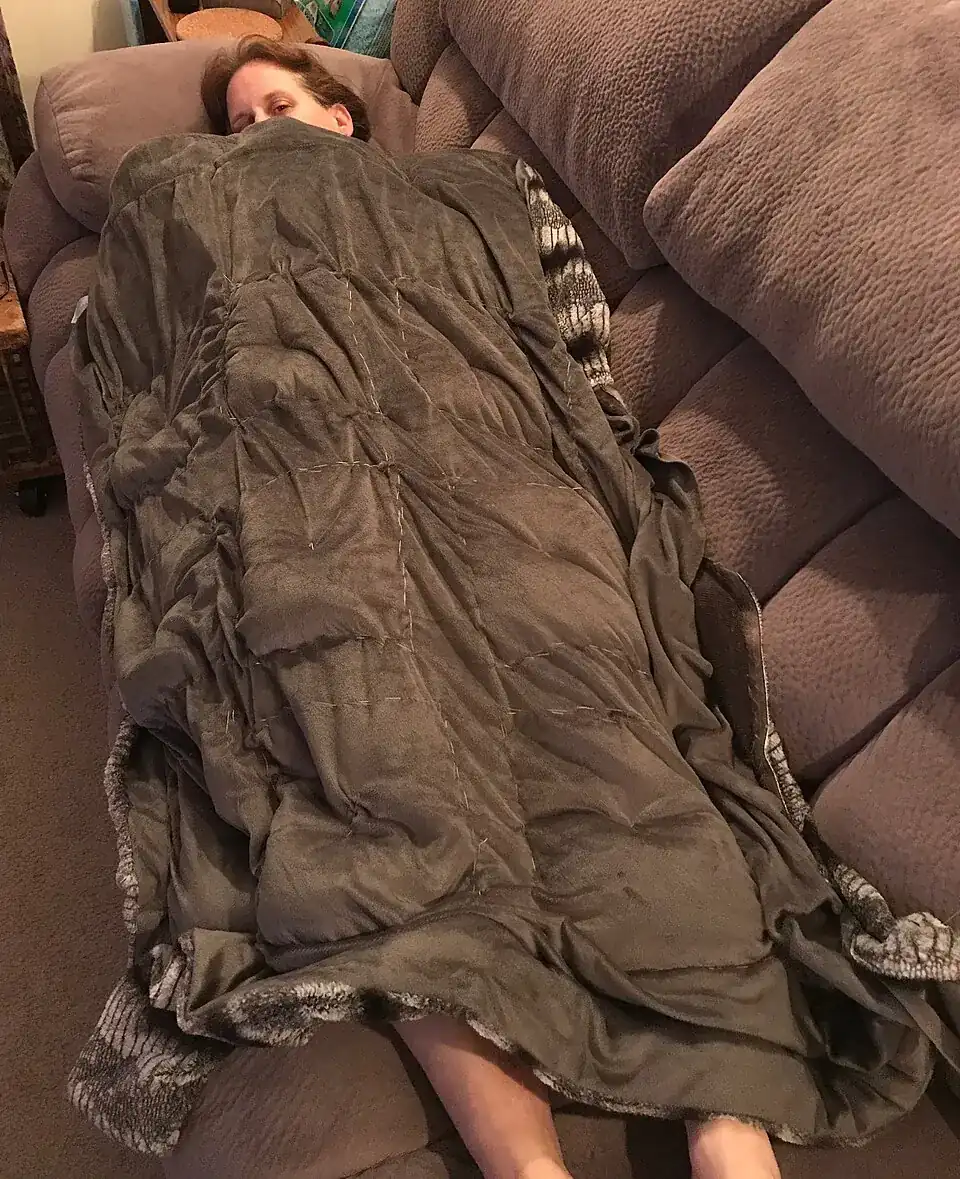
A woman resting beneath a weighted blanket
SleepStress & wellbeingVaries · Easy · Moderate
Reviewed Sep 24, 2026
Save

Scientific evidence

What the research shows

Outcome assessments based on research, including its uncertainties and limitations.

Sleep outcomes in the populations that have been randomised

Finding: Mixed evidenceCertainty: Limitedstudies disagree, or the effect depends on who is studied

Evidence basis: randomised trials

Randomised trials agree that weighted blankets are well tolerated and disagree completely about sleep, because each tested a different population.

Population: 120 adults with major depressive disorder, bipolar disorder, generalised anxiety disorder or ADHD and insomnia in a four-week randomised trial with a subsequent open-label follow-up; 73 autistic children with severe sleep problems in a randomised placebo-controlled crossover trial using actigraphy; 94 children with ADHD (mean age 9.0 years, 57.4% boys) in a randomised controlled crossover trial. No retrieved randomised trial enrolled healthy adults without a sleep or psychiatric diagnosis.

Research details

Summary

Three randomised trials test weighted blankets against a lighter blanket, and their results diverge by population rather than by chance. In 120 adults with major depressive disorder, bipolar disorder, generalised anxiety disorder or ADHD and comorbid insomnia, a weighted metal chain blanket produced a large improvement in Insomnia Severity Index ratings over a light plastic chain blanket at four weeks (Cohen's d 1.90, P < .001), with better sleep maintenance, higher daytime activity and reduced daytime fatigue, depression and anxiety symptoms; the authors conclude that weighted chain blankets are an effective and safe intervention for insomnia in these patients. In autistic children with severe sleep problems, the result is null on every objective measure: actigraphy showed the weighted blanket did not increase total sleep time once baseline was adjusted for, there were no group differences in any other objective or subjective measure of sleep including behavioural outcomes, and the authors state plainly that the blanket did not help the children sleep longer, fall asleep faster or wake less often - yet parents and children preferred it. In 94 children with ADHD, the effects were small and did not cover sleep onset: total sleep time increased by 7.72 minutes, sleep efficiency by 0.82 percentage points and wake after sleep onset fell by 2.79 minutes, with sleep-onset latency unchanged (p = 0.432). The three trials measured different outcomes in different populations over different durations, so the honest synthesis is a directionless one: the evidence supports a substantial benefit in one clinical group, a small partial benefit in another and no benefit at all in a third, and pooling them into a single estimate would hide exactly the finding a reader needs.

Why this certainty

Rated Limited and recorded as Mixed evidence. The designs are randomised, which is why this is not graded lower, and each trial is internally credible about the population it studied. It is not Moderate because the trials disagree with each other and the disagreement is not statistical noise but a difference in who was studied and what was measured; because the largest effect is a self-reported outcome that participants could not be blinded to; because the null trial and the small-effect trial used objective actigraphy that a preference cannot influence; and because no trial has been conducted in the general adult population the product is sold to. Pooling the three into one universal estimate would produce a number that describes none of them, so the entry states the heterogeneity instead of averaging it away.

Limitations

The trial populations are not interchangeable, so no single effect estimate applies: one enrolled adults with psychiatric diagnoses, one autistic children and one children with ADHD, and the outcomes measured across them differ (a subjective insomnia questionnaire in the first, actigraphy in the second, actigraphy in the third). The largest effect is also the most subjective: the adults' result rests on the Insomnia Severity Index, a self-reported scale, in a trial that could not blind participants to whether their blanket was heavy, and expectancy is a plausible part of a d of 1.90. The null result in autistic children came from a crossover design whose washout and habituation behaviour with a heavy blanket are difficult to control, and preference findings were collected from parents and children who could tell which blanket was which. The ADHD trial's effects are small in absolute terms - under eight minutes of total sleep time - and it did not change the latency most insomniacs care about. Every trial is short (four weeks to a few months), none measured falls, injury, overheating or long-term use, and the trials excluded people with significant respiratory, circulatory or skin conditions, which is also why the safety claims in this literature are narrower than they read. No trial randomised healthy adults sleeping normally, so the general marketing claim is untested.

Effect estimate

Adults with psychiatric diagnoses and insomnia (n = 120, 4 weeks): Insomnia Severity Index advantage for the weighted chain blanket over a light blanket, Cohen's d 1.90, P < .001. Autistic children (n = 73, crossover): no increase in actigraphically measured total sleep time after adjustment for baseline, and no group difference in any other objective or subjective sleep measure; parents and children preferred the weighted blanket. Children with ADHD (n = 94, crossover): total sleep time +7.72 min (p = 0.027, d = 0.24), sleep efficiency +0.82% (p = 0.038, d = 0.23), wake after sleep onset -2.79 min (p = 0.015, d = -0.27), sleep-onset latency not significant (p = 0.432). No pooled estimate is reported because the populations and outcomes are not comparable.

Tolerability, preference and safety in the randomised trials

Finding: Benefit supportedCertainty: Limitedstudies found a benefit from doing this

Evidence basis: randomised trials

The one consistent finding across populations is that weighted blankets are tolerated and preferred, which is not the same as a sleep benefit.

Population: 120 adults with psychiatric diagnoses and insomnia over four weeks; 73 autistic children with severe sleep problems in a crossover; 94 children with ADHD in a crossover. All three trials excluded participants for whom added pressure or heat was judged a risk.

Research details

Summary

Every randomised trial that reports tolerability found the weighted blanket acceptable, and in two of the three that is where the positive findings stop. In the trial of 120 adults with psychiatric diagnoses, the authors describe weighted chain blankets as an effective and safe intervention and report improved daytime activity alongside the sleep result, indicating people used them rather than abandoning them. In autistic children, parents and children favoured the weighted blanket on subjective preference measures while every objective sleep measure was unchanged. In children with ADHD, the crossover design was completed by the enrolled sample with actigraphy recorded in both arms, which is the practical evidence that a weighted blanket can be slept under for weeks at a time. This is a genuine and consistent finding, and it is deliberately kept separate from the sleep outcome because preference is what the trials actually agree on and sleep is what they do not. It is graded Limited rather than higher because none of the trials was designed as a tolerability study: adverse events were not a pre-specified outcome in any of them, the populations excluded people with respiratory, circulatory and skin conditions where added pressure or heat could matter, and the follow-up is weeks. The entry therefore reports preference as the reliable part of the literature and does not convert it into a claim about sleep.

Why this certainty

Rated Limited and recorded as Benefit supported. It is higher than Very limited because all three trials point the same way on acceptability and none reports a tolerability failure, and it is not Moderate because preference was unblinded, adverse events were not a pre-specified outcome, and the follow-up is weeks. The finding is recorded as a benefit for tolerability rather than for sleep so that the two are never read as one claim.

Limitations

This outcome is about tolerability and preference, not about sleep, and the distinction is the point: the same trials that report preference also report a large benefit in one population and no objective benefit in another, so a reader must not read this as corroboration of the sleep result. No trial pre-specified adverse events as a primary outcome, and the absence of reported harm over four weeks in people screened for respiratory, circulatory and skin conditions does not speak to long-term use, to children who cannot remove a blanket themselves, or to anyone those exclusions removed. Preference was measured in unblinded participants who could feel which blanket was heavy, so it is a satisfaction measure rather than a masked tolerability measure. The adult trial's safety language comes from its own authors and covers the trial population and duration only.

Effect estimate

Adults with psychiatric diagnoses and insomnia: the trial reports weighted chain blankets as effective and safe, with improved daytime activity; autistic children: parents and children favoured the weighted blanket on subjective preference measures while all objective sleep measures were unchanged; children with ADHD: no tolerability failure reported and both crossover arms completed with actigraphy.

What people say

Who discusses this?

Public statements, with positions specific to each source and topic. These views do not determine the scientific evidence assessment.

What the research shows ↑

No sourced public statements added for this habit yet. This does not mean no one discusses it.

Practical steps and precautions

How to try it

  1. Choose a weight that still lets you move, turn over, and breathe comfortably.
  2. Check the manufacturer's guidance on weight, washing, and heat before buying, because weighted bedding is difficult to clean.
  3. Treat any change you notice as personal comfort rather than as a treatment effect: the randomised evidence is genuinely mixed, and the largest reported benefit belongs to adults with a psychiatric diagnosis and insomnia rather than to healthy sleepers.
  4. Do not expect an objective sleep improvement on the strength of these trials. In the autistic-children trial the objective measures did not move at all despite a clear preference for the blanket, which is the clearest evidence in the set that feeling better about a blanket and sleeping measurably better are different things.

Precautions

  • Do not use a weighted blanket with an infant, a small child, or anyone who cannot remove it independently.
  • Ask a clinician first if you have a condition where added pressure or heat is a concern.
  • The trials that exist excluded people with significant respiratory, circulatory or skin conditions and ran for weeks rather than years, so long-term tolerability in those groups is unstudied.

References

A randomized controlled study of weighted chain blankets for insomnia in psychiatric disorders.

Ekholm B, Spulber S, Adler M · Journal of clinical sleep medicine : JCSM : official publication of the American Academy of Sleep Medicine · 2020

Randomized controlled trial of a weighted metal chain blanket against a light plastic chain blanket over 4 weeks in adults with psychiatric diagnoses and comorbid insomnia, with a 12-month open follow-up phase; 120 patients randomised 1:1. Abstract-level verification, no open-access full text located.Verified from abstract
Open original source

Weighted blankets and sleep in autistic children--a randomized controlled trial.

Gringras P, Green D, Wright B, Rush C, Sparrowhawk M, Pratt K, Allgar V, Hooke N, Moore D, Zaiwalla Z, Wiggs L · Pediatrics · 2014

Randomized placebo-controlled crossover trial of weighted blankets against a control blanket in autistic children with severe sleep problems, using actigraphy with adjustment for baseline total sleep time plus parent- and child-reported preference; abstract-level verification, no open-access full text located.Verified from abstract
Open original source

The efficacy of weighted blankets for sleep in children with attention-deficit/hyperactivity disorder-A randomized controlled crossover trial.

Lönn M, Svedberg P, Nygren J, Jarbin H, Aili K, Larsson I · Journal of Sleep Research · 2024

Randomized controlled crossover trial of weighted blankets against a lighter control blanket in children with ADHD and sleep problems, with actigraphy and parent-reported measures; abstract-level verification, no open-access full text located.Verified from abstract
Open original source

Community

Discussion

Have you tried this? What helped or made it difficult?

Reader experiences are separate from the scientific evidence. Explore all discussions

No discussions yet.

Be the first to ask a question or share your experience.

Sign in to vote or join the discussion.

Explore other habits in a shared category. Each has its own evidence and precautions.

Editorial history and review method

Revision 7 · Approved for publication · Codex (publication approval explicitly authorized by site owner; category migration)

Prepared and checked with AI. Publication approval does not imply independent expert review. Request a correction.

Audit correction pass (group 6). Implementation step 3 ('Treat any change you notice as personal comfort rather than a documented effect') asserted that no documented effect exists, which the randomised literature contradicts, so it now says the trial evidence is mixed and population-specific and names the direction of the two clearest results. The verdict was extended so the entry no longer implies that randomised trials are absent. Two sources were added and retrieved to substantiate that wording: ekholm-2020-weighted-chain-blanket (120 adults with major depressive disorder, bipolar disorder, generalised anxiety disorder or ADHD; insomnia severity advantage over a light blanket at 4 weeks, Cohen's d 1.90, with a 12-month open follow-up) and gringras-2014-weighted-blanket-autism (randomised placebo-controlled crossover in 73 autistic children; no effect on actigraphy total sleep time or any other objective or subjective sleep measure, but parent and child preference for the weighted blanket). Coverage stays Basic with no outcomes, so nothing here is presented as an assessed claim. A second reviewer must re-check: (1) that the new verdict text cannot be read as an assessed outcome claim, since Basic coverage must not imply assessed outcomes; (2) whether the catalogue should instead convert this entry to Standard coverage with a real 'Mixed evidence / Limited / Randomized intervention' outcome, which the audit suggested and this pass deliberately did not do because it would change the entry's coverage class; (3) that precaution 1 (do not use with an infant, small child, or anyone who cannot remove it independently) is understood as a home-safety rule rather than an evidence-based contraindication — supervised use has been studied in NICU infants without adverse events; and (4) that the Lönn 2024 ADHD trial is not cited here, because it was retrieved from PubMed rather than Europe PMC and adding it was not required by the audit. Basic-entry reference pass: the three randomised trials the verdict describes are now cited as background references, so a reader can reach the trials whose disagreement the entry reports instead of taking the summary on trust. The entry still publishes no outcome assessment and the trials are not scored. A second reviewer must check whether this entry should become Standard: there are three randomised trials with a real population-dependent disagreement, which is arguably enough to assess as an outcome rather than describe, and the decision not to was a coverage-budget judgement rather than an evidence one. Coverage raised from Basic to Standard, because several randomised trials test the intervention directly and the Basic treatment was more conservative than the evidence warrants. Two outcomes now carry it: sleep-outcomes-by-population (Mixed evidence, Limited, Randomized intervention) and tolerability-and-preference (Benefit supported, Limited, Randomized intervention). The three existing sources were promoted from background references to assessed sources: Ekholm 2020 in adults with psychiatric diagnoses and insomnia (Cohen's d 1.90 on the Insomnia Severity Index against a light blanket), Gringras 2014 in autistic children (no increase in actigraphically measured total sleep time and no difference in any other sleep measure, with a clear subjective preference) and Lonn 2024 in children with ADHD (total sleep time +7.72 min, sleep efficiency +0.82 percentage points, wake after sleep onset -2.79 min, sleep-onset latency not significant). The three populations are deliberately not pooled, and the summary and certainty rationale say why: the effect sizes run from large to null and the outcomes measured differ. The verdict states that no retrieved trial has tested weighted blankets in healthy adults, so nothing in the entry supports the general claim that they improve sleep. The tolerability outcome exists because preference and acceptability are the only findings the trials agree on, and it is labelled as a tolerability finding rather than as corroboration of the sleep result. A second reviewer must check: (a) whether a Benefit supported label on an unblinded preference measure is acceptable under the catalogue's directness rule, or whether it should be described in prose without a finding; (b) whether the adults' d of 1.90 should be qualified further given that the comparison blanket was also a chain blanket and only the weight differed; (c) whether Standard coverage is right, or whether the absence of any trial in the general population the product is sold to argues for staying at Basic. Publication release 2026-10-04: site owner authorized a bounded AI audit and release of this exact revision. See docs/release-audit-2026-10-04.md for source-check findings and limits. No independent health-professional or peer review is claimed. Category migration 2026-10-04: removed the separate goals field; categories: Sleep → Sleep, Stress & wellbeing. Research assessments, sources, guidance, precautions, and evidence review dates are unchanged. This revision awaits publication approval; no new evidence review is claimed. Publication approval 2026-10-04: site owner explicitly accepted all current category-migration revisions for deployment and requested that remaining limitations be retained in docs/content-review-backlog.md. Approval applies to this exact content revision. No new evidence review, independent expert review, or clinical validation is claimed; existing precautions and disclosures remain in effect.