Skip to content
Back to results

Scheduled short breaks

Deliberately taking brief, scheduled breaks of a few minutes during desk or computer work, often with stretching or a change of posture.

At a glance

  • Evidence: Evidence that scheduled short breaks reduce musculoskeletal discomfort is mixed.Musculoskeletal discomfort and pain · Limited certainty · Randomized intervention
  • What’s uncertain: Trials are small, schedules vary widely, and the evidence for discomfort is rated very low certainty.
  • First step: Pick a repeatable prompt, such as a break of about 5 minutes each hour, and treat that interval as an editorial starting point: no included study established an optimal frequency or duration.
  • Before you try it: Change posture gradually, especially after long periods of sitting, and steady yourself if you feel light-headed on standing. All precautions

Takeaway

Short scheduled breaks appear to give a small boost to felt energy and may reduce discomfort, and they have not been shown to harm productivity. The pooled performance benefit was not statistically significant overall, the Cochrane review rated the musculoskeletal evidence very low certainty, and no included study established an optimal break frequency or duration, so any schedule is a personal starting point rather than an evidence-based prescription.

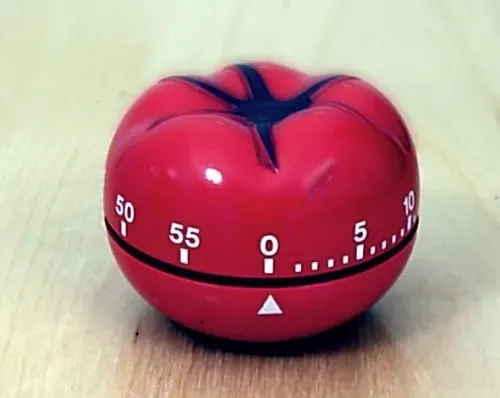
A tomato-shaped timer for the Pomodoro technique
FocusEnergyUnder 10 min · Easy · Free
Reviewed Sep 21, 2026
Save

Scientific evidence

What the research shows

Outcome assessments based on research, including its uncertainties and limitations.

Musculoskeletal discomfort and pain

Finding: Mixed evidenceCertainty: Limitedstudies disagree, or the effect depends on who is studied

Evidence basis: randomised trials

Evidence that scheduled short breaks reduce musculoskeletal discomfort is mixed.

Population: Mainly office and computer workers: 626 workers in the Cochrane review (at least 75% female, 98% office workers); 8 RCTs and 3 non-randomized trials in the earlier systematic review; computer terminal keyers in one randomized trial; plus a 6-month cohort of operating-room nurses (not desk workers).

Research details

Summary

Evidence that scheduled short breaks reduce musculoskeletal discomfort is mixed. A Cochrane review of 9 RCTs (626 workers, 98% office workers) judged all evidence very low certainty and found little to no difference in back discomfort (SMD -0.04), although one small trial reported reduced back pain intensity. An earlier systematic review found moderate-quality evidence that active breaks with postural change reduce pain and discomfort, and a trial in computer keyers found microbreaks reduced discomfort in all muscle areas studied, most clearly with breaks every 20 min.

Why this certainty

Pooled estimates are imprecise and inconsistent between syntheses, most trials are small with unclear or high risk of bias, and the one moderate-quality GRADE finding concerns active breaks with postural change specifically rather than short breaks in general. Certainty limited by risk of bias, imprecision and heterogeneity.

Limitations

All Cochrane outcomes had some bias concerns or high risk of bias and were rated very low certainty; trials were small (5 studies, 372 participants for back discomfort) and break schedules highly heterogeneous (work periods 5 min to 2 h, breaks 20 s to 30 min); the 6-month supporting cohort used a non-randomized design and a non-desk population; the narrative review performed no risk-of-bias assessment.

Effect estimate

Additional work-breaks versus conventional work-breaks: back discomfort SMD -0.04 (95% CI -0.24 to 0.17; 5 studies, 372 participants); back pain intensity MD -0.91 (95% CI -1.45 to -0.38; 1 study, 147 participants); new-onset back pain RR 0.58 (95% CI 0.30 to 1.11; 1 study, 147 participants) (Cochrane 2025).

Fatigue and vigour (perceived energy)

Finding: Benefit supportedCertainty: Limitedstudies found a benefit from doing this

Evidence basis: randomised trials

Micro-breaks show small but statistically significant benefits for felt energy.

Population: Employees and students in experimental and quasi-experimental micro-break studies (22 independent samples, 2,335 participants; k = 9 samples each for vigour and fatigue), plus office workers in the Cochrane review (2 studies, 146 participants for active work-breaks).

Research details

Summary

Micro-breaks show small but statistically significant benefits for felt energy. A meta-analysis of 22 independent samples (2,335 participants) found micro-breaks increased vigour (d = 0.36) and reduced fatigue (d = 0.35), both significant. A Cochrane review, however, found little to no difference in physiological musculoskeletal fatigue for active or cognitive work-breaks versus conventional breaks, with very low certainty.

Why this certainty

One meta-analysis shows consistent, statistically significant but small benefits for self-reported vigour and fatigue, while an independent Cochrane synthesis found no clear effect on physiological musculoskeletal fatigue and rated the evidence very low. Certainty limited by small pooled samples, short follow-up and construct heterogeneity.

Limitations

Effects are small, based on only 9 samples each, and mostly measured in short laboratory or single-day protocols rather than real work settings; the Cochrane physiological fatigue estimates are very low certainty with confidence intervals crossing no effect; self-reported vigour, self-reported fatigue and physiological musculoskeletal fatigue are not directly comparable constructs.

Effect estimate

Vigour d = 0.36 (p < 0.001; k = 9, n = 913) and fatigue d = 0.35 (p < 0.001; k = 9, n = 803) favouring micro-breaks (Albulescu 2022); active versus conventional work-breaks for intensity of physiological musculoskeletal fatigue SMD -0.23 (95% CI -0.55 to 0.10; 2 studies, 146 participants) (Cochrane 2025).

Work performance and productivity

Finding: Mixed evidenceCertainty: Limitedstudies disagree, or the effect depends on who is studied

Evidence basis: randomised trials

Micro-breaks do not appear to harm productivity, but evidence of improved performance is weak.

Population: Office workers, computer keyers, students and general adult samples: 15 samples (1,132 participants) in the pooled performance analysis; 9 RCTs (626 workers, 98% office workers) in the Cochrane review; office workers in the GRADE-rated systematic review.

Research details

Summary

Micro-breaks do not appear to harm productivity, but evidence of improved performance is weak. The meta-analysis found a non-significant pooled effect on overall performance (d = 0.16), with significant benefits only for tasks with less cognitive demand and greater gains with longer breaks. A systematic review found moderate-quality evidence that breaks had no detrimental effect on work productivity, and a randomized trial in computer keyers likewise found no productivity loss.

Why this certainty

Evidence consistently shows no harm to productivity, but the only pooled estimate for improved performance was null and imprecise, with benefits restricted to specific task types and longer breaks in exploratory analyses. Certainty limited by imprecision, heterogeneity and indirect performance measures.

Limitations

The pooled performance effect was non-significant and heterogeneous; subgroup and meta-regression findings are exploratory; the Cochrane review rated productivity evidence very uncertain and reported no pooled estimate in the retrieved abstract; outcome measures range from typing output to laboratory cognitive tasks, limiting comparability; most studies are short-term.

Effect estimate

Overall performance d = 0.16 (p = 0.116; k = 15, n = 1,132), non-significant, with significant effects only for tasks with less cognitive demands (Albulescu 2022). Mixed/uncertain evidence for work productivity in the Cochrane review; moderate-quality GRADE evidence of no detrimental effect on work productivity (Waongenngarm 2018).

Objectively measured muscle activation patterns (electromyography)

Finding: Mixed evidenceCertainty: Very limitedstudies disagree, or the effect depends on who is studied

Evidence basis: randomised trials

Only one small randomized trial examined physiological muscle behaviour during keying work.

Population: Computer terminal workers performing their usual keying work, randomly assigned to one of three groups: microbreaks at their own discretion, microbreaks at 20-minute intervals, or microbreaks at 40-minute intervals.

Research details

Summary

Only one small randomized trial examined physiological muscle behaviour during keying work. Microbreaks were associated with a higher frequency of mean-frequency cycling in wrist extensor muscles, in the neck for the discretionary and 40-minute break protocols, and in the back for the 20- and 40-minute protocols, but no significant change was seen at the shoulder. The clinical meaning of these electromyographic changes for injury prevention remains undetermined.

Why this certainty

One trial, a surrogate physiological outcome, no verifiable effect sizes or sample size, and no independent replication. Certainty rated very limited.

Limitations

Single small randomized trial; only the abstract was retrieved, so sample size, effect sizes and risk of bias could not be verified; mean-frequency cycling of the myoelectric signal is a surrogate measure whose relationship to discomfort or cumulative trauma disorders is described by the authors themselves as remaining to be determined.

What people say

Who discusses this?

Public statements, with positions specific to each source and topic. These views do not determine the scientific evidence assessment.

What the research shows ↑

No sourced public statements added for this habit yet. This does not mean no one discusses it.

Practical steps and precautions

How to try it

  1. Pick a repeatable prompt, such as a break of about 5 minutes each hour, and treat that interval as an editorial starting point: no included study established an optimal frequency or duration.
  2. Use the break for a brief change of posture or a short stretch rather than staying seated; active breaks with postural change had the most supportive (moderate-quality) evidence.
  3. Expect small effects on how tired you feel and little or no measurable change in output, because the pooled performance benefit was not statistically significant overall.
  4. Judge it on your own discomfort and energy over a few weeks, since the desk-worker evidence is short-term, small and mostly from office populations.

Precautions

  • Change posture gradually, especially after long periods of sitting, and steady yourself if you feel light-headed on standing.
  • Stop any stretch or movement that causes pain; the microbreak studies used gentle ergonomic movements, not strenuous exercise.
  • If discomfort persists or worsens despite regular breaks, seek advice from a health professional rather than relying on breaks alone.

References

Work-break interventions for preventing musculoskeletal symptoms and disorders in healthy workers

Luger T, Ferenchak SA, Rieger MA, Steinhilber B · Cochrane Database of Systematic Reviews · 2025

Cochrane systematic review and meta-analysis of randomized controlled trials, with Cochrane RoB 2 risk-of-bias assessment and GRADE certainty ratingVerified from abstract
Open original source

The effects of breaks on low back pain, discomfort, and work productivity in office workers: A systematic review of randomized and non-randomized controlled trials

Waongenngarm P, Areerak K, Janwantanakul P · Applied Ergonomics · 2018

Systematic review of randomized and non-randomized controlled trials with methodological quality and GRADE assessmentVerified from abstract
Open original source

Computer terminal work and the benefit of microbreaks

McLean L, Tingley M, Scott RN, Rickards J · Applied Ergonomics · 2001

Randomized experimental study comparing microbreak protocols during usual keying work, measuring myoelectric signal behaviour, perceived discomfort and productivityVerified from abstract
Open original source

The Effect of Physiotherapy Interventions in the Workplace through Active Micro-Break Activities for Employees with Standing and Sedentary Work

Vitoulas S, Konstantis V, Drizi I, Vrouva S, Koumantakis GA, Sakellari V · Healthcare (Basel) · 2022

Narrative review with systematic search of randomized controlled trials of active workplace micro-breaks (PEDro quality screening, no quantitative synthesis)Verified from abstract
Open original source

Long-Term Effects of Structured Microbreak Interventions on Musculoskeletal Health, Psychological Wellbeing, and Patient Safety Among Operating Room Nurses: A Multicenter Longitudinal Cohort Study

Gao W, Fan G, Liu D, Fan G · Journal of Healthcare Leadership · 2025

Non-randomized controlled multicenter mixed-methods cohort study with six-month follow-up (N = 178 analyzed)Verified from full text
Open original source

"Give me a break!" A systematic review and meta-analysis on the efficacy of micro-breaks for increasing well-being and performance

Albulescu P, Macsinga I, Rusu A, Sulea C, Bodnaru A, Tulbure BT · PLOS ONE · 2022

Systematic review and meta-analysis of experimental and quasi-experimental studies of micro-breaksVerified from abstract
Open original source

Community

Discussion

Have you tried this? What helped or made it difficult?

Reader experiences are separate from the scientific evidence. Explore all discussions

No discussions yet.

Be the first to ask a question or share your experience.

Sign in to vote or join the discussion.

Explore other habits in a shared category. Each has its own evidence and precautions.

Editorial history and review method

Revision 3 · Approved for publication · Codex (publication approval explicitly authorized by site owner; category migration)

Prepared and checked with AI. Publication approval does not imply independent expert review. Request a correction.

Evidence semantics migrated: findings now describe doing the habit, evidence basis is explicit, and the catalogue card uses an editorially selected claim. Four outcomes assessed from one micro-break meta-analysis (Albulescu 2022; 22 independent samples, 2,335 participants), the 2025 Cochrane review of work-break interventions (9 RCTs, 626 workers, all evidence very low certainty, all studies with some bias concerns or high risk of bias), a GRADE-rated systematic review in office workers (Waongenngarm 2018), one randomized microbreak trial in computer keyers (McLean 2001), a narrative review of active workplace micro-breaks (Vitoulas 2022) and one six-month non-randomized cohort in operating-room nurses (Gao 2025). Gao 2025 and O'Callaghan 2018 were the only sources read in full; Vitoulas 2022 was retrieved as partial full text and is therefore recorded as abstract, as are all other sources. A second reviewer must re-check: (1) that the habit text never implies a proven performance gain, because the pooled performance effect was non-significant (d = 0.16, p = 0.116) and the Cochrane productivity evidence was very uncertain; (2) that no optimal break frequency or duration is asserted, since the Cochrane review explicitly found that no included study investigated break duration; (3) the internal inconsistency in Vitoulas 2022, which states both 15 and 13 RCTs; (4) the patient-satisfaction discrepancy within Gao 2025 (+1.5 vs +0.5 points in the abstract versus +1.3 vs +0.4 points in the results text) and the fact that its population was operating-room nurses rather than desk workers. A large 2026 pragmatic trial of movement breaks for prolonged sitting was deliberately excluded to avoid duplicating the separate sitting-interruption topic. Publication release 2026-10-04: site owner authorized a bounded AI audit and release of this exact revision. See docs/release-audit-2026-10-04.md for source-check findings and limits. No independent health-professional or peer review is claimed. Category migration 2026-10-04: removed the separate goals field; categories: Focus, Energy → Focus, Energy. Research assessments, sources, guidance, precautions, and evidence review dates are unchanged. This revision awaits publication approval; no new evidence review is claimed. Publication approval 2026-10-04: site owner explicitly accepted all current category-migration revisions for deployment and requested that remaining limitations be retained in docs/content-review-backlog.md. Approval applies to this exact content revision. No new evidence review, independent expert review, or clinical validation is claimed; existing precautions and disclosures remain in effect.