Skip to content
Back to results

Limit processed meat

The person deliberately keeps processed meats such as bacon, ham, sausages, salami, hot dogs, and deli meats low in their usual diet, treating them as occasional rather than daily foods.

At a glance

  • Evidence: Pooled prospective cohorts link higher processed meat intake to roughly 17-21% higher colorectal cancer risk, on low-certainty evidence.Colorectal cancer incidence · Limited certainty · Observational association
  • What’s uncertain: All of the pooled evidence is observational, so residual confounding by overall diet, body weight, smoking, alcohol and socioeconomic position cannot be excluded, and dietary intake was self-reported in most cohorts.
  • First step: Treat processed meat as an occasional food rather than a daily one: the pooled dose-response curves rise with each additional 50 g per day, and the associations are strongest at high intakes.
  • Before you try it: Processed meat is a meaningful source of protein, iron, zinc and vitamin B12 for some people; if intake is very low overall, make sure those nutrients are covered from other foods. All precautions
Read the full takeaway

Observed disease associations

The direction of the evidence is unusually consistent: across several independent umbrella reviews and dose-response meta-analyses, higher processed meat intake is associated with more colorectal cancer, more cardiovascular disease, more type 2 diabetes and slightly higher all-cause mortality, and processed meat carries a formal IARC classification as carcinogenic to humans. The most recent comprehensive pooling of 60 prospective studies puts colorectal cancer risk about 21% higher in the highest versus lowest intake category.

Limits and practical interpretation

Where the evidence stops is causality and magnitude: the same syntheses rate the certainty low to very low, a systematic review of 55 cohorts concluded the association with mortality and cardiometabolic outcomes is 'very small', and a Bradford Hill assessment found that experimental studies of risk factors were mostly null while observational associations for cardiovascular disease were weak. Limiting processed meat is therefore a reasonable, low-cost precaution, not a proven way to prevent disease.

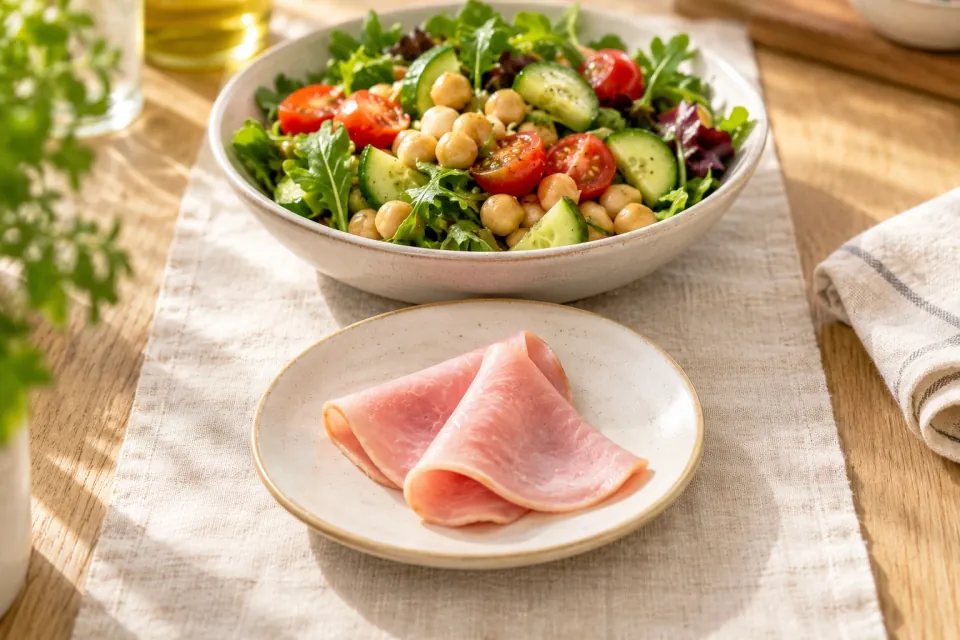
A modest serving of sliced ham beside a larger bowl of chickpeas and fresh vegetables
NutritionLong-term healthUnder 10 min · Easy · Low
Reviewed Sep 23, 2026
Save

Scientific evidence

What the research shows

Outcome assessments based on research, including its uncertainties and limitations.

Colorectal cancer incidence

Finding: Benefit supportedCertainty: Limitedstudies found a benefit from doing this

Evidence basis: observational studies (association, not proof of cause)

Pooled prospective cohorts link higher processed meat intake to roughly 17-21% higher colorectal cancer risk, on low-certainty evidence.

Population: Adults in prospective cohort studies: 60 cohorts in the largest 2025 meta-analysis, 148 published articles in the 2021 systematic review, and 34 articles with 54 meta-analyses in the most recent umbrella review.

Research details

Summary

The largest and most recent pooling of prospective studies located 60 cohorts and found that processed meat consumption was associated with colorectal cancer (HR 1.21, 95% CI 1.14-1.28), colon cancer (HR 1.13, 95% CI 1.07-1.20) and rectal cancer (HR 1.17, 95% CI 1.05-1.30) when the highest intake category was compared with the lowest. A 2021 systematic review of 148 articles reported a smaller colorectal cancer estimate for processed meat (18% higher risk) alongside a 21% higher colon cancer risk and a 22% higher rectal cancer risk, and an earlier dose-response meta-analysis of prospective studies found that each 50 g per day of processed meat carried a relative risk of 1.18 (95% CI 1.10-1.28). An umbrella review of 34 articles and 54 meta-analyses reported that each additional 50 g per day of processed meat was associated with a 17% higher colorectal cancer risk, though it also concluded, citing the International Agency for Research on Cancer and the World Cancer Research Fund, that no level of processed meat intake can be confidently considered safe. The consistency of direction across independent syntheses is the main strength of this outcome.

Why this certainty

Rated Limited. The direction replicates across many independent prospective cohorts, which makes chance an unlikely explanation, and processed meat is one of the few dietary exposures with a formal carcinogenicity classification. Certainty is held down because every contributing source is observational, the most recent umbrella review graded the underlying associations low to very low, and absolute risk differences for an individual eating a moderate amount are small — so the evidence supports a precaution rather than a demonstrated protective effect of cutting back.

Limitations

All of the pooled evidence is observational, so residual confounding by overall diet, body weight, smoking, alcohol and socioeconomic position cannot be excluded, and dietary intake was self-reported in most cohorts. The most recent umbrella review rated the dose-response associations as based on low to very low certainty evidence by GRADE. The magnitude is modest — around a 17-21% relative difference between extreme intake categories — and in the earlier dose-response analysis the association for rectal cancer was not significant, while another pooling found the positive association for pancreatic cancer applied only to red meat, with no significant association for processed meat products.

Effect estimate

Colorectal cancer, highest versus lowest processed meat intake: HR 1.21 (95% CI 1.14-1.28) across 60 prospective studies; per 50 g/day: RR 1.18 (95% CI 1.10-1.28).

Cardiovascular disease and cardiovascular mortality

Finding: Mixed evidenceCertainty: Limitedstudies disagree, or the effect depends on who is studied

Evidence basis: observational studies (association, not proof of cause)

Cohort syntheses associate processed meat with 17-27% higher cardiovascular risk, but randomised and experimental findings are mostly null.

Population: Adults in meta-analyses of prospective cohorts: 40 meta-analyses in the umbrella review of non-cancer outcomes, and 55 cohorts with more than 4 million participants in the GRADE-assessed systematic review of cohort studies.

Research details

Summary

An umbrella review of 40 meta-analyses of non-cancer outcomes found that an additional 50 g per day of processed meat was associated with a 27% higher risk of coronary heart disease (95% CI 1.09-1.49), a 17% higher risk of stroke (95% CI 1.02-1.34) and an 8% higher risk of heart failure (95% CI 1.02-1.14). A meta-analysis of 55 cohorts with more than 4 million participants found low-certainty evidence that reducing processed meat intake by 3 servings per week is associated with a very small decrease in risk for cardiovascular mortality, stroke and myocardial infarction. A Bradford Hill appraisal of 29 reviews reached a different conclusion: observational assessments of cardiovascular outcomes reported consistently weak associations, and experimental assessments of cardiovascular risk factors were predominantly not significant, which the authors judged to lack coherence with the observational findings and to suggest that red and processed meat intakes are not likely causally related to cardiovascular disease. The divergence between the observational and experimental arms is the central finding here. Ren 2026, an umbrella review of 34 articles and 54 meta-analyses, reports a smaller and non-significant association for coronary heart disease when the highest intake category is compared with the lowest (RR 1.15, 95% CI 0.99 to 1.33), so the 27% figure applies to the per-50-g/day dose-response contrast rather than to the extreme-category contrast.

Why this certainty

Rated Limited rather than Moderate. Large observational syntheses agree on direction and the confidence intervals exclude no effect, but the certainty rating exists precisely because the two largest and most rigorous assessments disagree about what the association means: one calls the effect very small and low-certainty, the other judges the evidence incoherent with experimental data. With no randomised trial of clinical cardiovascular events, the causal question stays open, and a rating higher than Limited would overstate what has been shown.

Limitations

The umbrella review summarised existing meta-analyses descriptively without re-analysing estimates or calculating prediction intervals, so overlapping cohorts are counted more than once across the source reviews. The cohort meta-analysis rated its own findings low certainty because of inadequate adjustment for known confounders, residual confounding from the observational design, and recall bias in dietary measurement. The Bradford Hill review found that the experimental evidence on cardiovascular risk factors was mostly null, so the mechanism by which processed meat would raise cardiovascular risk in humans is not established.

Effect estimate

Coronary heart disease per 50 g/day processed meat: RR 1.27 (95% CI 1.09-1.49); stroke RR 1.17 (95% CI 1.02-1.34); heart failure RR 1.08 (95% CI 1.02-1.14).

Incident type 2 diabetes in relation to processed meat

Finding: Benefit supportedCertainty: Limitedstudies found a benefit from doing this

Evidence basis: observational studies (association, not proof of cause)

Each extra 50 g per day of processed meat is associated with about 19-37% higher type 2 diabetes risk in pooled cohorts.

Population: Adults in prospective cohort studies contributing to meta-analyses: 40 meta-analyses in the umbrella review of non-cancer outcomes, 20 studies with 1,218,380 individuals and 10,797 diabetes cases in the earlier pooling, and 55 cohorts with more than 4 million participants in the GRADE-assessed review.

Research details

Summary

An umbrella review of 40 meta-analyses found that the highest dose-response increment per 50 g of processed meat was a relative risk of 1.37 (95% CI 1.22-1.55) for type 2 diabetes, the largest estimate among the non-cancer outcomes it examined. A much earlier systematic review and meta-analysis of 20 studies covering 1,218,380 individuals found processed meat intake associated with a 19% higher risk of diabetes mellitus per 50 g serving per day (RR 1.19, 95% CI 1.11-1.27), while red meat intake was not associated with diabetes in the same analysis (RR 1.16, 95% CI 0.92-1.46). In the GRADE-assessed review of 55 cohorts, reduction in processed meat intake of 3 servings per week was associated with a very small decrease in type 2 diabetes risk on low-certainty evidence. The 2024 Bradford Hill appraisal judged the association with type 2 diabetes to be stronger than for cardiovascular disease and considered a causal relationship possible, while noting that evidence for unprocessed red meat and diabetes was insufficient. The same Bradford Hill appraisal found that experimental assessments of type 2 diabetes risk factors were predominantly not significant, as they were for cardiovascular risk factors, so the coherence argument for diabetes rests on observational strength rather than on experimental support.

Why this certainty

Rated Limited. The association is replicated across independent syntheses and the type 2 diabetes signal is one of the larger ones in this literature, which is why the finding is recorded as supported. It is not rated higher because every contributing estimate comes from observational cohorts, the magnitude varies several-fold between syntheses, and the only formal certainty assessments available rate the evidence low, so the size of any benefit from cutting intake cannot be quantified from these data.

Limitations

The evidence is observational and diet was self-reported, so measurement error and residual confounding by body weight, physical activity and overall diet quality are likely. The type 2 diabetes estimate is derived from meta-analyses that share overlapping cohorts, and the umbrella review did not re-analyse the data or account for this overlap. Effect sizes differ substantially between sources (19% versus 37% per 50 g/day), which reflects differences in comparison definitions and study sets rather than a stable quantity, and the GRADE-assessed cohort review rated the supporting evidence low certainty.

Effect estimate

Type 2 diabetes, highest dose-response increment per 50 g/day processed meat: RR 1.37 (95% CI 1.22-1.55); per 50 g serving per day in the earlier pooling: RR 1.19 (95% CI 1.11-1.27).

All-cause mortality, and the limits of the evidence overall

Finding: Mixed evidenceCertainty: Very limitedstudies disagree, or the effect depends on who is studied

Evidence basis: observational studies (association, not proof of cause)

Higher processed meat intake tracks with roughly 15-23% higher all-cause mortality, but the same reviews call the effect very small and low-certainty.

Population: Adults in prospective cohort studies: 40 meta-analyses in the umbrella review, nine prospective studies in one mortality meta-analysis, 17 prospective cohorts with 150,328 deaths in a dose-response meta-analysis, and 55 cohorts with more than 4 million participants in the GRADE-assessed review.

Research details

Summary

An umbrella review of non-cancer outcomes found that the highest dose-response increment of processed meat consumption was associated with a relative risk of 1.15 (95% CI 1.11-1.19) for all-cause mortality per 50 g increase. A separate meta-analysis, which included nine prospective studies and pooled six of them for processed meat, reported a summary relative risk of 1.23 (95% CI 1.17-1.28) for the highest versus lowest category of processed meat, compared with a non-significant 1.10 (95% CI 0.98-1.22) for unprocessed red meat, and an earlier dose-response meta-analysis of 17 prospective cohorts found a pooled relative risk of 1.15 (95% CI 1.11-1.19) per one serving per day for all-cause mortality. The counterweight is explicit in the same literature: the GRADE-assessed review of 55 cohorts with more than 4 million participants concluded that the magnitude of association between processed meat consumption and all-cause mortality and adverse cardiometabolic outcomes is 'very small' and that the evidence is of low certainty, and its companion review of dietary patterns found low- to very-low-certainty evidence that patterns lower in red and processed meat produce very small or possibly small decreases in mortality. No randomised trial has tested whether people who reduce processed meat intake live longer.

Why this certainty

Rated Very limited. This outcome is recorded as the honest ceiling on the whole habit: the largest and most rigorous assessment available explicitly concludes that the effect is very small and the evidence low certainty, and that review, not the more favourable poolings, is the one that used GRADE across 55 cohorts and more than 4 million participants. The association itself is statistically robust, which is why it is reported at all, but robustness is not the same as a demonstrated benefit of changing intake, and no randomised evidence exists to support the stronger claim.

Limitations

Every estimate is observational, and people who eat little processed meat tend to have healthier lifestyles in general, so substantial residual confounding cannot be excluded — a point the source reviews make directly. The magnitude of association is small and is expressed per 50 g/day or per serving/day, which makes it sensitive to how a serving is defined and to misreporting of diet. The GRADE-assessed review found inadequate adjustment for known confounders and recall bias, and the companion dietary-pattern review rated its evidence low to very low. Because no trial has tested the effect of reducing intake on mortality, the honest conclusion is that the association is consistent in direction but unproven as a causal lever.

Effect estimate

All-cause mortality per 50 g/day processed meat: RR 1.15 (95% CI 1.11-1.19); highest versus lowest intake: RR 1.23 (95% CI 1.17-1.28).

What people say

Who discusses this?

Public statements, with positions specific to each source and topic. These views do not determine the scientific evidence assessment.

What the research shows ↑

No sourced public statements added for this habit yet. This does not mean no one discusses it.

Practical steps and precautions

How to try it

  1. Treat processed meat as an occasional food rather than a daily one: the pooled dose-response curves rise with each additional 50 g per day, and the associations are strongest at high intakes.
  2. Swap the habitual slot instead of just removing it — replace a daily deli-meat sandwich or breakfast sausage with eggs, fish, poultry, legumes, or a nut-and-yoghurt breakfast, since the evidence is about total dietary pattern rather than one food in isolation.
  3. Read labels for cured, salted, smoked, canned and 'nitrite-treated' products, which is the definition used by the epidemiological studies, rather than only counting red meat.
  4. When you do eat it, keep the portion small and infrequent rather than trying to find a 'safe' processed product, because the reviewed evidence found no level that could confidently be called safe.

Precautions

  • Processed meat is a meaningful source of protein, iron, zinc and vitamin B12 for some people; if intake is very low overall, make sure those nutrients are covered from other foods.
  • Do not let this habit displace oily fish, legumes or unprocessed meat in a way that reduces overall diet quality — the substitution matters as much as the removal.
  • The evidence is observational, so the honest framing of this habit is risk reduction at the population level, not a personal guarantee.
  • If you have a personal or family history of colorectal cancer, discuss screening separately: no dietary change replaces it.

References

Association between red and processed meat consumption and colorectal cancer risk: a comprehensive meta-analysis of prospective studies.

Ungvari Z, Fekete M, Varga P, Lehoczki A, Munkacsy G, Fekete JT, Bianchini G, Ocana A, Buda A, Ungvari A, Gyorffy B · GeroScience · 2025

Systematic review and meta-analysis of prospective cohort studiesVerified from full text
Open original source

Consumption of red meat and processed meat and cancer incidence: a systematic review and meta-analysis of prospective studies.

Farvid MS, Sidahmed E, Spence ND, Mante Angua K, Rosner BA, Barnett JB · European journal of epidemiology · 2021

Systematic review and meta-analysis of prospective studiesVerified from abstract
Open original source

Red and processed meat and colorectal cancer incidence: meta-analysis of prospective studies.

Chan DS, Lau R, Aune D, Vieira R, Greenwood DC, Kampman E, Norat T · PloS one · 2011

Systematic review and dose-response meta-analysis of prospective studiesVerified from full text
Open original source

A comprehensive evaluation of epidemiological evidence on processed meat intake in relation to cancer, cardiovascular, metabolic diseases and all-cause mortality: an umbrella review.

Ren J, Ablimit M, Maimaitiaili T, Tuoheti Z, Jing Z, Jiao D, Xue H, Ablat N · Frontiers in public health · 2026

Umbrella review of systematic reviews and meta-analysesVerified from full text
Open original source

Red/processed meat consumption and non-cancer-related outcomes in humans: umbrella review.

Zhang X, Liang S, Chen X, Yang J, Zhou Y, Du L, Li K · The British journal of nutrition · 2023

Umbrella review of systematic reviews and meta-analysesVerified from abstract
Open original source

Red and Processed Meat Consumption and Risk for All-Cause Mortality and Cardiometabolic Outcomes: A Systematic Review and Meta-analysis of Cohort Studies.

Zeraatkar D, Han MA, Guyatt GH, Vernooij RWM, El Dib R, Cheung K, Milio K, Zworth M, Bartoszko JJ, Valli C, Rabassa M, Lee Y, Zajac J, Prokop-Dorner A, Lo C, Bala MM, Alonso-Coello P, Hanna SE, Johnston BC · Annals of internal medicine · 2019

Systematic review and meta-analysis of cohort studies with GRADE assessmentVerified from abstract
Open original source

Red and processed meat intakes and cardiovascular disease and type 2 diabetes mellitus: An umbrella systematic review and assessment of causal relations using Bradford Hill's criteria.

Hill ER, O'Connor LE, Wang Y, Clark CM, McGowan BS, Forman MR, Campbell WW · Critical reviews in food science and nutrition · 2024

Umbrella systematic review with Bradford Hill causal assessmentVerified from abstract
Open original source

Red and processed meat consumption and risk of incident coronary heart disease, stroke, and diabetes mellitus: a systematic review and meta-analysis.

Micha R, Wallace SK, Mozaffarian D · Circulation · 2010

Systematic review and dose-response meta-analysis of prospective cohorts and case-control studiesVerified from full text
Open original source

Patterns of Red and Processed Meat Consumption and Risk for Cardiometabolic and Cancer Outcomes: A Systematic Review and Meta-analysis of Cohort Studies.

Vernooij RWM, Zeraatkar D, Han MA, El Dib R, Zworth M, Milio K, Sit D, Lee Y, Gomaa H, Valli C, Swierz MJ, Chang Y, Hanna SE, Brauer PM, Sievenpiper J, de Souza R, Alonso-Coello P, Bala MM, Guyatt GH, Johnston BC · Annals of internal medicine · 2019

Systematic review and meta-analysis of prospective cohort studies with GRADE assessmentVerified from abstract
Open original source

Red meat and processed meat consumption and all-cause mortality: a meta-analysis.

Larsson SC, Orsini N · American journal of epidemiology · 2014

Systematic review and dose-response meta-analysis of prospective studiesVerified from abstract
Open original source

Red and processed meat consumption and mortality: dose-response meta-analysis of prospective cohort studies.

Wang X, Lin X, Ouyang YY, Liu J, Zhao G, Pan A, Hu FB · Public health nutrition · 2016

Dose-response meta-analysis of prospective cohort studiesVerified from abstract
Open original source

Community

Discussion

Have you tried this? What helped or made it difficult?

Reader experiences are separate from the scientific evidence. Explore all discussions

No discussions yet.

Be the first to ask a question or share your experience.

Sign in to vote or join the discussion.

Explore other habits in a shared category. Each has its own evidence and precautions.

Editorial history and review method

Revision 8 · Approved for publication · Codex (publication approval explicitly authorized by site owner; category migration)

Prepared and checked with AI. Publication approval does not imply independent expert review. Request a correction.

Applied the group-2 audit. Wang 2016 (nine articles, seventeen prospective cohorts, 150,328 deaths, processed meat RR 1.15 per one serving per day) was the source of a numeric claim that was not in the file; it has been retrieved and is now cited from all-cause-mortality. The headline ranges were wrong: colorectal-cancer-incidence went from 'roughly 16-21%' to 'roughly 17-21%' and all-cause-mortality from 'roughly 8-23%' to 'roughly 15-23%' (the 8% belonged to heart failure in a different outcome). The IARC attribution was overstated and now reads as the umbrella review's own conclusion drawn from IARC and the World Cancer Research Fund, not a formal IARC position. The Larsson 2014 attribution now records that nine prospective studies were included but six were pooled for processed meat. Added counter-evidence that the outcome's own sources report: Ren 2026's null highest-versus-lowest coronary heart disease estimate (RR 1.15, 95% CI 0.99-1.33) in the cardiovascular outcome, and Hill 2024's predominantly null experimental assessments of type 2 diabetes risk factors in the diabetes outcome. Second reviewer must re-check: (a) whether the source list should stay at its current size, since the 17-cohort claim is now sourced rather than deleted; (b) that no reader-facing copy converts the hazard ratios into 'risk' without qualification; (c) the remaining Larsson 2014 processed-meat estimate of 1.23, which is a highest-versus-lowest contrast rather than a dose-response one. Outcome-label disambiguation: the outcome is now titled 'Incident type 2 diabetes in relation to processed meat', so its Benefit supported finding is no longer compared against differently-exposed diabetes outcomes in other entries. The finding and certainty are unchanged. The finding and certainty are unchanged. The finding and certainty are unchanged. The finding and certainty are unchanged. The finding and certainty are unchanged. Publication release 2026-10-04: site owner authorized a bounded AI audit and release of this exact revision. See docs/release-audit-2026-10-04.md for source-check findings and limits. No independent health-professional or peer review is claimed. Category migration 2026-10-04: removed the separate goals field; categories: Nutrition, Long-term health → Nutrition, Long-term health. Research assessments, sources, guidance, precautions, and evidence review dates are unchanged. This revision awaits publication approval; no new evidence review is claimed. Publication approval 2026-10-04: site owner explicitly accepted all current category-migration revisions for deployment and requested that remaining limitations be retained in docs/content-review-backlog.md. Approval applies to this exact content revision. No new evidence review, independent expert review, or clinical validation is claimed; existing precautions and disclosures remain in effect.