
Skip to content
Back to results

Train muscular power with appropriate fast movement

Practise suitable movements with a fast intended lifting or propulsion phase and a controlled return, using manageable resistance and sound technique.

At a glance

  • Evidence: Power training may modestly improve some functional tests in older adults.Physical function compared with conventional strength training · Limited certainty · Randomized intervention
  • What’s uncertain: Its advantage over conventional strength training and clinical importance remain uncertain.
  • First step: Learn a controlled movement and choose a manageable load before adding speed.
  • Before you try it: Use adapted coaching if joint, bone or balance problems affect the movement. All precautions

Takeaway

Power training emphasizes producing force quickly while keeping the movement controlled. Reviews of randomized trials in older adults found modest advantages over conventional resistance training on some physical-function tests, but similar or uncertain results on others. A small review comparing training loads did not find clearly better power gains with heavier resistance. This supports considering appropriate power work within a training programme, without claiming that it prevents falls, extends lifespan or requires heavy, technically demanding lifts.

ExerciseLong-term health10–20 min · Moderate · Low
Reviewed Oct 3, 2026
Save

Scientific evidence

What the research shows

Outcome assessments based on research, including its uncertainties and limitations.

Physical function compared with conventional strength training

Finding: Mixed evidenceCertainty: Limitedstudies disagree, or the effect depends on who is studied

Evidence basis: randomised trials

Power training has modest advantages on some functional tests, with uncertain clinical importance.

Population: Adults mostly aged over 60 in randomized comparisons of fast-intended lifting and conventional resistance training.

Research details

Summary

A 2022 review included 20 trials and 566 community-living older adults. Physical function improved modestly versus conventional strength training in 13 trials (SMD 0.30, 95% CI 0.05 to 0.54), with low-certainty evidence. A 2023 review of 19 trials and 1,055 participants found small advantages on the Short Physical Performance Battery and Timed Up and Go, but substantial uncertainty for other outcomes and whether differences were clinically worthwhile.

Why this certainty

Limited because some test-specific effects are consistent but the advantage is small, heterogeneous and of uncertain clinical importance. Transfer to younger adults and unsupervised routines is less certain.

Limitations

The reviews overlap and are not independent replications. Small trials, risk of bias, imprecision and incomplete exercise reporting limit certainty; findings do not establish fall prevention or lifespan extension.

Effect estimate

Physical-function SMD 0.30 (95% CI 0.05 to 0.54), 13 trials in the 2022 review.

Power gains with lower versus higher training loads

Finding: Mixed evidenceCertainty: Limitedstudies disagree, or the effect depends on who is studied

Evidence basis: randomised trials

Heavier power-training loads did not clearly produce greater power gains in a small review.

Population: 179 older adults in three randomized trials comparing power-training load ranges.

Research details

Summary

A review of three trials with 179 older adults compared lower/moderate with higher power-training intensities. Differences in power gains were not significant for leg press or knee extension. Higher intensity improved maximal strength more for one exercise, so power and maximal-strength outcomes should not be treated as interchangeable.

Why this certainty

Limited because the evidence base is small and does not define one ideal load or personal prescription. The finding supports avoiding a universal requirement for heavy loading.

Limitations

Only three studies were included and results were exercise-specific. A non-significant difference is not proof that all loads are equivalent or that any movement is suitable for an individual.

What people say

Who discusses this?

Public statements, with positions specific to each source and topic. These views do not determine the scientific evidence assessment.

What the research shows ↑

Practical steps and precautions

How to try it

  1. Learn the movement slowly first, then choose a version you can perform with stable positioning and control.
  2. Use a manageable load and intend to move quickly during the lifting or propulsion phase; control the return rather than rushing the whole repetition.
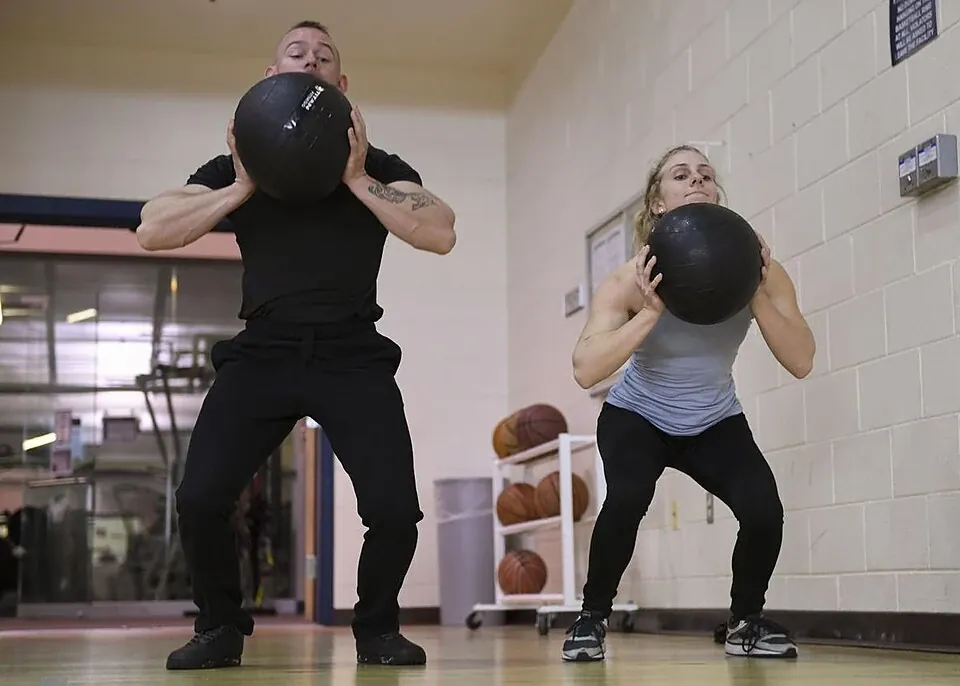
  3. Choose an appropriate option with a coach or physiotherapist when needed, such as a light medicine-ball throw or a supported rise from a chair. Jumps and Olympic lifts are optional advanced choices.
  4. Practise while fresh, rest enough to preserve speed and stop the set when control or movement quality deteriorates.

Precautions

  • Get an adapted programme if you have osteoporosis, recent surgery, significant joint pain, balance limitations or a condition that restricts exercise.
  • Do not turn every exercise into a maximal-speed or maximal-load effort; technique and a safe movement area come first.

References

Comparison of Power Training vs Traditional Strength Training on Physical Function in Older Adults: A Systematic Review and Meta-analysis.

Balachandran AT, Steele J, Angielczyk D, Belio M, Schoenfeld BJ, Quiles N, Askin N, Abou-Setta AM. · JAMA network open · 2022

Systematic reviewSystematic review and meta-analysis of randomized intervention trialsVerified from abstract
Open original source

High-velocity power training has similar effects to traditional resistance training for functional performance in older adults: a systematic review.

Morrison RT, Taylor S, Buckley J, Twist C, Kite C. · Journal of physiotherapy · 2023

Systematic reviewSystematic review and meta-analysis of randomized intervention trialsVerified from abstract
Open original source

Chronic Effects of Different Intensities of Power Training on Neuromuscular Parameters in Older People: A Systematic Review with Meta-analysis.

Bandeira-Guimarães M, Blanco-Rambo E, Vieira AF, Sáez de Asteasu ML, Pinto RS, Izquierdo M, Cadore EL. · Sports medicine - open · 2023

Systematic reviewSystematic review and meta-analysis of randomized intervention trialsVerified from abstract
Open original source

Community

Discussion

Have you tried this? What helped or made it difficult?

Reader experiences are separate from the scientific evidence. Explore all discussions

No discussions yet.

Be the first to ask a question or share your experience.

Sign in to vote or join the discussion.

Explore other habits in a shared category. Each has its own evidence and precautions.

Editorial history and review method

Revision 2 · Approved for publication · Codex (publication approval explicitly authorized by site owner; category migration)

Prepared and checked with AI. Publication approval does not imply independent expert review. Request a correction.

Verified the retrieved human-study abstracts and original-publisher video metadata. Independent editorial approval remains pending; recheck applicability, uncertainty and adapted implementation before approval. Publication release 2026-10-04: site owner authorized a bounded AI audit and release of this exact revision. See docs/release-audit-2026-10-04.md for source-check findings and limits. No independent health-professional or peer review is claimed. Category migration 2026-10-04: removed the separate goals field; categories: Exercise, Long-term health → Exercise, Long-term health. Research assessments, sources, guidance, precautions, and evidence review dates are unchanged. This revision awaits publication approval; no new evidence review is claimed. Publication approval 2026-10-04: site owner explicitly accepted all current category-migration revisions for deployment and requested that remaining limitations be retained in docs/content-review-backlog.md. Approval applies to this exact content revision. No new evidence review, independent expert review, or clinical validation is claimed; existing precautions and disclosures remain in effect.