
Skip to content
Back to results

Practice balance training

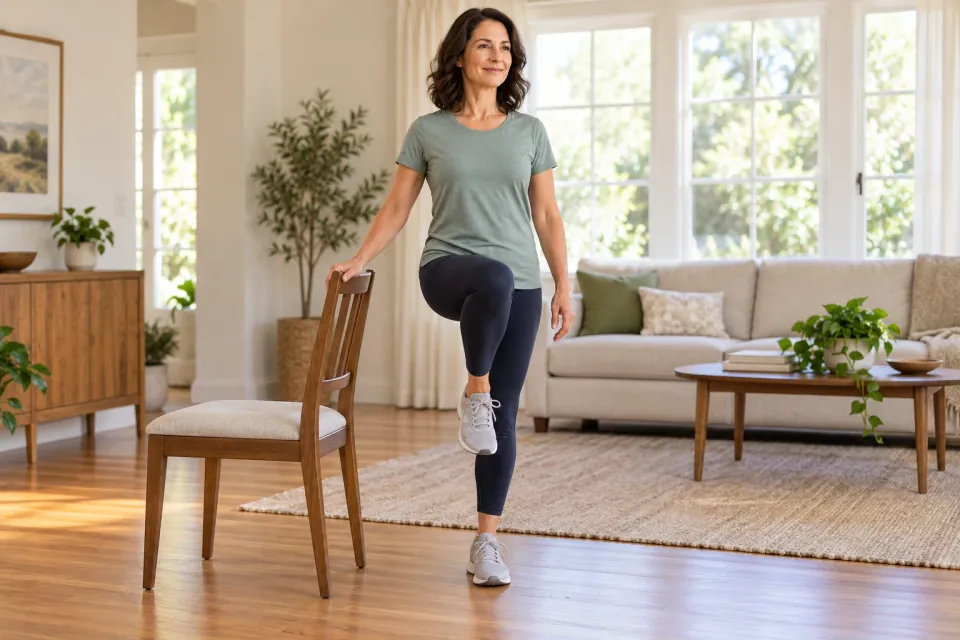
Practice supported standing, stepping, or other exercises that challenge balance and functional movement at a level suited to your ability.

At a glance

  • Evidence: Balance and functional exercise programmes reduce fall rates in community-dwelling older adults.Falls among community-dwelling older adults · Moderate certainty · Randomized intervention
  • What’s uncertain: Most trials had unclear or high risk of bias for at least one item, and adverse events were monitored closely in only one trial.
  • First step: Choose exercises that safely challenge balance, such as controlled weight shifts, stepping in different directions, or a suitable class.
  • Before you try it: Use support and clear the area to reduce fall risk during practice. All precautions

Takeaway

A Cochrane synthesis of randomized trials found that balance and functional exercise programmes reduce falls among older adults living in the community. A separate review for the US Preventive Services Task Force also found exercise interventions had the most consistent benefits across fall outcomes. The studies tested varied programmes, and their results should not be assumed to apply equally to every age, health condition, or unsupervised exercise.

ExerciseLong-term health10–20 min · Moderate · Free
Reviewed Sep 22, 2026
Save

Scientific evidence

What the research shows

Outcome assessments based on research, including its uncertainties and limitations.

Falls among community-dwelling older adults

Finding: Benefit supportedCertainty: Moderatestudies found a benefit from doing this

Evidence basis: randomised trials

Balance and functional exercise programmes reduce fall rates in community-dwelling older adults.

Population: Community-dwelling adults aged 60 years or older across randomized fall-prevention trials; average participant age was 76 in the Cochrane synthesis.

Research details

Summary

The Cochrane review included 108 randomized trials with 23,407 participants, whose average age was 76. Compared with control, balance and functional exercise reduced the rate of falls by 24% (rate ratio 0.76, 95% CI 0.70 to 0.81; 39 studies, 7,920 participants) and the number of people experiencing one or more falls by 13%. A 2024 review for the US Preventive Services Task Force also found exercise interventions had the most consistent benefit across fall-related outcomes. The evidence concerns organized exercise programmes in older adults, not a guaranteed effect for any one exercise.

Why this certainty

The Cochrane synthesis is large and rates the balance/functional subgroup evidence highly, with corroboration from a separate evidence review. Certainty is rated Moderate here because of trial heterogeneity, risk-of-bias concerns, and limited harms monitoring.

Limitations

Most trials had unclear or high risk of bias for at least one item, and adverse events were monitored closely in only one trial. Exercise programmes varied, so the review does not identify a single universally optimal balance routine.

Effect estimate

Fall rate ratio 0.76 (95% CI 0.70 to 0.81) for balance and functional exercise versus control.

Balance and mobility performance

Finding: Benefit supportedCertainty: Limitedstudies found a benefit from doing this

Evidence basis: randomised trials

A small yoga trial synthesis found improved balance and mobility measures, but it did not establish that every balance routine has the same effect.

Population: Adults aged 60 years or older in six yoga-based exercise trials, totaling 307 participants.

Research details

Summary

A systematic review of six trials in 307 adults aged 60 years or older reported a small-to-moderate improvement in balance after yoga-based exercise (Hedges g 0.40, 95% CI 0.15 to 0.65). This provides adjacent evidence that structured movement can improve measured balance, but yoga is only one form of training and the studies were small. The review did not show that this score change translates into fewer falls.

Why this certainty

The pooled estimate is positive but comes from a narrow and small evidence base. Limited certainty reflects the outcome’s indirectness to general balance practice and the lack of demonstrated translation to fall prevention.

Limitations

The trials were few and small, used yoga rather than a broad range of balance programmes, and measured performance outcomes rather than falls. Findings may not generalize to unsupervised exercise or people with high fall risk.

Effect estimate

Hedges g 0.40 (95% CI 0.15 to 0.65) for balance performance after yoga-based exercise.

What people say

Who discusses this?

Public statements, with positions specific to each source and topic. These views do not determine the scientific evidence assessment.

What the research shows ↑

Practical steps and precautions

How to try it

  1. Choose exercises that safely challenge balance, such as controlled weight shifts, stepping in different directions, or a suitable class.
  2. Begin beside a stable support and progress gradually; use a qualified instructor or physical therapist if you have a history of falls or significant mobility limits.
  3. Practice regularly and include functional movements rather than relying only on standing still on one leg.

Precautions

  • Use support and clear the area to reduce fall risk during practice.
  • If you have recurrent falls, dizziness, new weakness, or a medical condition affecting balance, ask a clinician or physical therapist to tailor the exercises.

References

Exercise for preventing falls in older people living in the community.

Sherrington C, Fairhall NJ, Wallbank GK, Tiedemann A, Michaleff ZA, Howard K, Clemson L, Hopewell S, Lamb SE · The Cochrane database of systematic reviews · 2019

Cochrane systematic review and meta-analysis of 108 randomised controlled trials with 23,407 community-dwelling participants aged 60 and over, with GRADE assessment. Facts are quoted from the retrieved abstract. Full-text accessibility rechecked on 2026-10-04: Europe PMC lists the record as not open access; the NCBI XML response explicitly says the publisher does not allow downloading the full text, and publisher/PMC HTML could not be retrieved. This record remains abstract-checked.Verified from abstract
Open original source

Interventions to Prevent Falls in Older Adults: Updated Evidence Report and Systematic Review for the US Preventive Services Task Force

Guirguis-Blake JM, Perdue LA, Coppola EL, Bean SI · JAMA · 2024

Systematic review of exercise and multifactorial fall-prevention interventions in community-dwelling older adultsVerified from abstract
Open original source

Yoga-based exercise improves balance and mobility in people aged 60 and over: a systematic review and meta-analysis

Youkhana S, Dean CM, Wolff M, Sherrington C, Tiedemann A · Age and Ageing · 2016

Systematic review and meta-analysis of trials of physical yoga on balance in people aged 60 and over, with PEDro scale methodological quality assessment and random-effects pooling; searches to February 2015 (PROSPERO CRD42015015872)Verified from abstract
Open original source

Community

Discussion

Have you tried this? What helped or made it difficult?

Reader experiences are separate from the scientific evidence. Explore all discussions

No discussions yet.

Be the first to ask a question or share your experience.

Sign in to vote or join the discussion.

Explore other habits in a shared category. Each has its own evidence and precautions.

Editorial history and review method

Revision 3 · Approved for publication · Codex (publication approval explicitly authorized by site owner; category migration)

Prepared and checked with AI. Publication approval does not imply independent expert review. Request a correction.

Adds two outcome assessments and adult-population limits, using the Cochrane falls review, USPSTF evidence review, and existing yoga review. Recheck the safety language and avoid implying all exercise types have equivalent evidence. Europe PMC lookup returned empty results in this runtime, so source facts were checked against retrieved PubMed or journal records; recheck the source metadata and access status before approval. Publication release 2026-10-04: site owner authorized a bounded AI audit and release of this exact revision. See docs/release-audit-2026-10-04.md for source-check findings and limits. No independent health-professional or peer review is claimed. Category migration 2026-10-04: removed the separate goals field; categories: Exercise, Long-term health → Exercise, Long-term health. Research assessments, sources, guidance, precautions, and evidence review dates are unchanged. This revision awaits publication approval; no new evidence review is claimed. Publication approval 2026-10-04: site owner explicitly accepted all current category-migration revisions for deployment and requested that remaining limitations be retained in docs/content-review-backlog.md. Approval applies to this exact content revision. No new evidence review, independent expert review, or clinical validation is claimed; existing precautions and disclosures remain in effect.