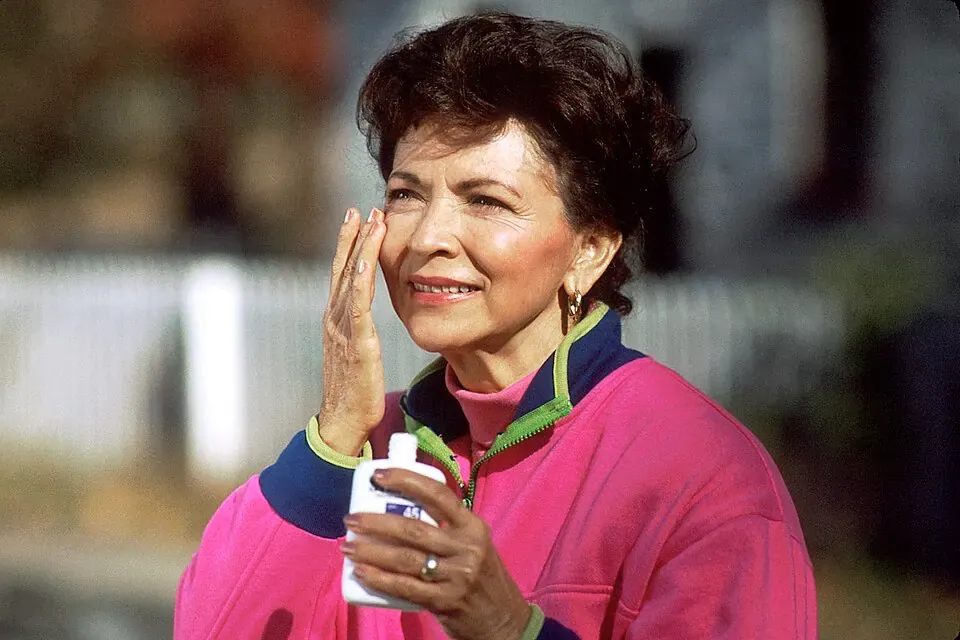
Melanoma, squamous cell carcinoma and skin ageing
Evidence basis: randomised trials
Daily sunscreen use in a randomised trial was followed by about half the melanoma rate and 40 percent fewer squamous cell carcinomas, with no clear effect on basal cell carcinoma.
Population: 1,621 randomly selected residents of Nambour, Queensland aged 25 to 75 in a randomised trial of daily versus discretionary sunscreen, with 903 adults under 55 contributing the skin-ageing outcome; and 29 observational studies and one controlled trial involving 313,717 participants and 10,670 skin cancer cases in the meta-analysis.
Research details
Summary
In the Nambour trial, 1,621 randomly selected residents of Queensland aged 25 to 75 were assigned in 1992 to daily or discretionary sunscreen application to head and arms alongside beta carotene or placebo, and followed to 2006. Ten years after trial cessation, 11 new primary melanomas had been identified in the daily sunscreen group and 22 in the discretionary group (hazard ratio 0.50; 95% CI 0.24 to 1.02; P = .051), with a larger reduction in invasive melanomas (n = 3 versus 11; HR 0.27; 95% CI 0.08 to 0.97) than in preinvasive melanomas (HR 0.73; 95% CI 0.29 to 1.81). Over extended follow-up of the same trial, squamous cell carcinoma tumour rates were significantly decreased by almost 40 percent (rate ratio 0.62; 95% CI 0.38 to 0.99) while basal cell carcinoma rates tended to decrease but not significantly. A separate analysis of 903 adults under 55 from the same trial found skin ageing from baseline to the end of the trial was 24 percent less in the daily sunscreen group than in the discretionary group (relative odds 0.76; 95% CI 0.59 to 0.98), and beta carotene had no overall effect. Going the other way, a meta-analysis of 29 studies involving 313,717 participants and 10,670 cases found no significant overall association between skin cancer and sunscreen use (OR 1.08; 95% CI 0.91 to 1.28) and stated that its results do not confirm the expected protective benefits of sunscreen against skin cancer in the general population.
Why this certainty
Rated Moderate. Randomised allocation is a genuine strength and is rare in this field, and the direction of effect is consistent across three outcomes measured in the same trial, two of which reached statistical significance. Certainty is not Strong because the evidence rests on one trial in one location with a borderline melanoma result and an imprecise invasive melanoma estimate, and because the largest synthesis of observational data on the same question was null. Certainty is not lower because the trial evidence is randomised, the outcomes are clinical rather than surrogate, and the squamous cell carcinoma and skin-ageing findings are supported by the same randomised comparison.
Limitations
The randomised evidence comes from a single trial in one high-ultraviolet Australian township, so it may not transfer to lower-ultraviolet settings, to different skin types, or to modern higher-SPF formulations; the trial product was an SPF 16 broad-spectrum sunscreen applied to head, neck, hands and forearms only. The melanoma result did not reach conventional statistical significance (P = .051) and its confidence interval reached 1.02, and the invasive melanoma analysis rested on 3 events in the active group against 11 in the control group. The skin-ageing analysis had some outcome data missing and, by the authors' own statement, only modest power to detect moderate treatment effects. The meta-analysis that found no protective association is composed almost entirely of case-control studies, in which people at highest risk of skin cancer are also the highest users of sunscreen, so its null result cannot be read as evidence that sunscreen does not work. No randomised trial has tested melanoma incidence as a primary endpoint in a general population.
Effect estimate
Daily versus discretionary sunscreen: melanoma hazard ratio 0.50 (95% CI 0.24-1.02) at 10 years after trial cessation; squamous cell carcinoma rate ratio 0.62 (95% CI 0.38-0.99) over extended follow-up; skin ageing relative odds 0.76 (95% CI 0.59-0.98).
- Reduced melanoma after regular sunscreen use: randomized trial follow-up.
- Prolonged prevention of squamous cell carcinoma of the skin by regular sunscreen use.
- Sunscreen and prevention of skin aging: a randomized trial.
- Use of sunscreen and risk of melanoma and non-melanoma skin cancer: a systematic review and meta-analysis.
- Sunscreen use and increased duration of intentional sun exposure: still a burning issue.