Skip to content
Back to results

Standing desks

A desk that allows work while standing, or while alternating between sitting and standing positions.

At a glance

  • What we know: This catalogue does not treat a standing desk as an evidence-backed intervention.
  • What’s uncertain: Sit-stand desks can reduce short-term sitting, but a lasting health benefit is not established; standing still is not the same as moving.
  • First step: If you have one, change position often rather than aiming for a standing target.
  • Before you try it: Prolonged static standing can cause discomfort, fatigue and leg swelling; a cohort also linked predominantly standing occupations with higher heart-disease risk. All precautions
Read the full takeaway

Standing and workplace sitting

This catalogue does not treat a standing desk as an evidence-backed intervention. Standing still is not the same as moving: sit-stand desks do reduce workplace sitting, by about 100 minutes a workday in the short term on low-quality evidence, but there is no evidence that this changes health outcomes and no evidence that the reduction persists beyond a year. The two sources behind those statements are listed as background references below.

Occupational standing

Prolonged occupational standing is itself associated with a higher risk of heart disease in a 12-year cohort, which is a reason not to treat standing as the goal.

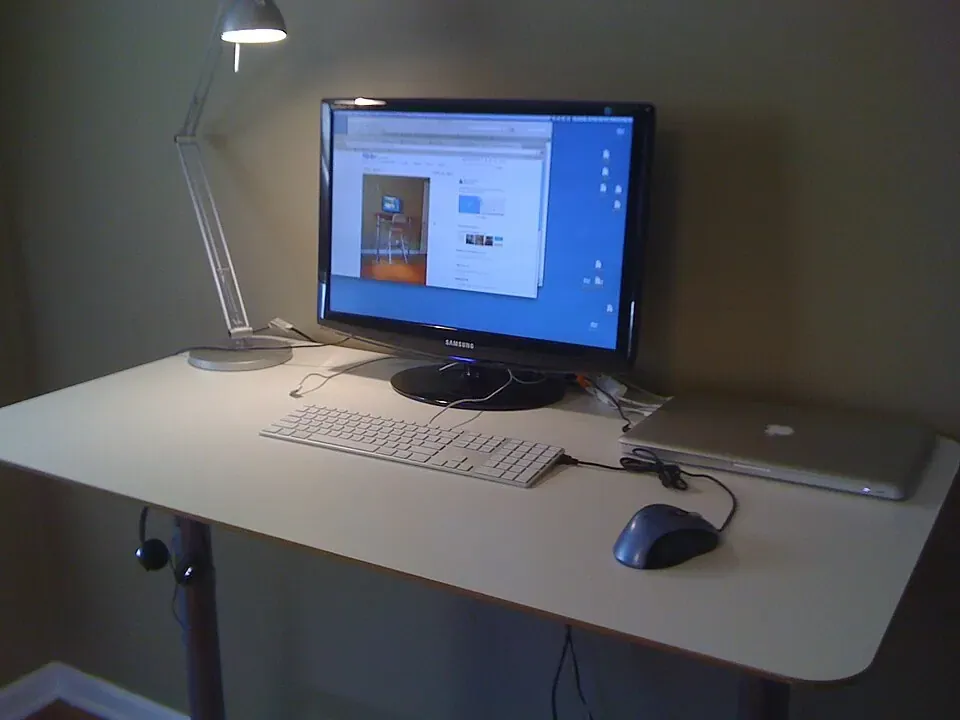
An office with a standing desk
ExerciseEnergyVaries · Easy · High
Reviewed Sep 23, 2026
Save

Scientific evidence

What the research shows

Outcome assessments based on research, including its uncertainties and limitations.

No outcome assessment published

This entry is an overview. Its background references do not establish whether the practice works.

What people say

Who discusses this?

Public statements, with positions specific to each source and topic. These views do not determine the scientific evidence assessment.

What the research shows ↑

No sourced public statements added for this habit yet. This does not mean no one discusses it.

Practical steps and precautions

How to try it

  1. If you have one, change position often rather than aiming for a standing target.
  2. Use each change of position as a cue to take a short walk or a break.
  3. Build the habit of movement first; the furniture is optional.

Precautions

  • Prolonged static standing can cause discomfort, fatigue, and swelling in the legs and feet, and one large cohort found that occupations involving predominantly standing carried about twice the risk of heart disease compared with predominantly sitting occupations.
  • Pregnancy, varicose veins, and some circulatory conditions need individual advice about long periods of standing.

References

Background and safety references

These support context and precautions; they are separate from assessed outcome sources.

Workplace interventions for reducing sitting at work.

Shrestha N, Kukkonen-Harjula KT, Verbeek JH, Ijaz S, Hermans V, Pedisic Z · The Cochrane database of systematic reviews · 2018

Cochrane systematic review of randomised trials and controlled before-and-after studiesVerified from abstractBackground or safety reference
Open original source

The Relationship Between Occupational Standing and Sitting and Incident Heart Disease Over a 12-Year Period in Ontario, Canada.

Smith P, Ma H, Glazier RH, Gilbert-Ouimet M, Mustard C · American journal of epidemiology · 2018

Prospective cohort study linked to administrative health recordsVerified from abstractBackground or safety reference
Open original source

Community

Discussion

Have you tried this? What helped or made it difficult?

Reader experiences are separate from the scientific evidence. Explore all discussions

No discussions yet.

Be the first to ask a question or share your experience.

Sign in to vote or join the discussion.

Explore other habits in a shared category. Each has its own evidence and precautions.

Editorial history and review method

Revision 6 · Approved for publication · Codex (publication approval explicitly authorized by site owner; category migration)

Prepared and checked with AI. Publication approval does not imply independent expert review. Request a correction.

Applied the group-1 audit. The verdict no longer says the equipment 'changes little', which Cochrane contradicts: sit-stand desks reduced workplace sitting by about 100 minutes a workday at short-term follow-up (95% CI -116 to -84, 10 studies, low-quality evidence) and 57 minutes a day at 3-12 months, with no evidence on longer follow-up and no evidence on health outcomes. Because standing-desk is Basic coverage it has no outcomes and therefore cannot attach a citation to that sentence, so the two supporting records (Shrestha 2018 Cochrane review, Smith 2018 cohort supporting precaution 1) were added to sources.json as documented provenance with the limitation recorded here. Second reviewer must decide whether the catalogue wants Basic-coverage entries to quantify the behavioural evidence they decline to assess, and note that the two new source records are intentionally not referenced from an outcome because the schema forbids outcomes on Basic entries. Basic-entry reference pass: the Cochrane review of workplace sitting interventions and the occupational-standing cohort study are now background references, and the precaution about prolonged standing now states what the cohort found rather than a general caution. The verdict also states the direction of the cohort finding, so a reader is not left thinking that standing more is automatically better. A second reviewer must check that the cohort's association is not read as a causal claim about standing desks specifically - it measured occupational standing, not desk use. Publication release 2026-10-04: site owner authorized a bounded AI audit and release of this exact revision. See docs/release-audit-2026-10-04.md for source-check findings and limits. No independent health-professional or peer review is claimed. Category migration 2026-10-04: removed the separate goals field; categories: Exercise, Energy → Exercise, Energy. Research assessments, sources, guidance, precautions, and evidence review dates are unchanged. This revision awaits publication approval; no new evidence review is claimed. Publication approval 2026-10-04: site owner explicitly accepted all current category-migration revisions for deployment and requested that remaining limitations be retained in docs/content-review-backlog.md. Approval applies to this exact content revision. No new evidence review, independent expert review, or clinical validation is claimed; existing precautions and disclosures remain in effect.