Skip to content
Back to results

Mouth taping

Taping the lips during sleep in an attempt to encourage nasal breathing, promoted largely through social media.

At a glance

  • What we know: Mouth taping has been studied, and the studies are too weak and too mixed to say whether it improves sleep or breathing.
  • What’s uncertain: Studies are poor quality, mixed and too different to pool; neither reliable benefit nor safety has been established.
  • First step: This catalogue records the practice without recommending a technique.
  • Before you try it: Do not tape your mouth if you have nasal congestion, a blocked nose, sleep apnoea or any breathing condition. All precautions
Read the full takeaway

Systematic reviews

Mouth taping has been studied, and the studies are too weak and too mixed to say whether it improves sleep or breathing. Three systematic reviews exist. The largest found ten studies in people who mouth-breathe or have sleep-disordered breathing and could not combine their results at all, because the designs and the reported outcomes were too different; every one of the ten was rated poor on risk of bias. A second review could pool nasal obstruction but not mouth taping, and narratively reviewed only two small non-randomised studies whose participants had a blocked nose excluded - which removes the very people for whom taping is most likely to matter, in both directions. A third, a scoping review, catalogues the social-media claims alongside a small literature it calls markedly heterogeneous with little consensus.

Trial and safety evidence

The only randomised trial that tested tape on its own was in adults with asthma, and it found no effect on asthma control. Harms have not been adequately studied: no study was designed to detect them, and the absence of reported adverse events in ten poor-quality studies is not reassurance that the practice is safe. Obstruction of the nasal airway is a medical problem that tape cannot fix, and closing the mouth in someone whose nose is blocked is a plausible mechanism for harm.

What the evidence cannot establish

None of that is proof that taping does nothing. It means the evidence is not good enough to estimate whether it helps, and the honest position is that this is a practice with a plausible risk and no demonstrated benefit rather than a disproven one. Anyone with nasal obstruction, snoring or a diagnosis of sleep apnoea should have the cause assessed rather than tape over it.

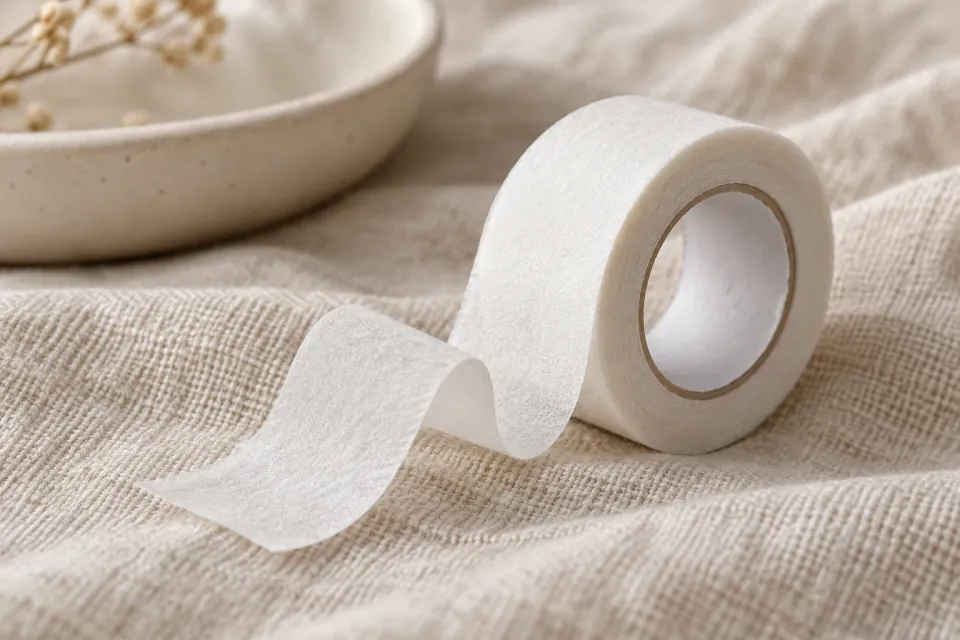
An unbranded roll of white medical paper tape
SleepEnergyUnder 10 min · Easy · Low
Reviewed Sep 24, 2026
Save

Scientific evidence

What the research shows

Outcome assessments based on research, including its uncertainties and limitations.

No outcome assessment published

This entry is an overview. Its background references do not establish whether the practice works.

What people say

Who discusses this?

Public statements, with positions specific to each source and topic. These views do not determine the scientific evidence assessment.

What the research shows ↑

No sourced public statements added for this habit yet. This does not mean no one discusses it.

Practical steps and precautions

How to try it

  1. This entry records a practice readers may encounter rather than recommending a technique; nothing here should be read as encouragement to try it, and nothing here should be read as proof that it is useless either.
  2. If nasal obstruction or snoring is the problem, treat that as a medical issue: it has causes that can be diagnosed and treated, and tape does not address any of them.
  3. If you are considering taping because of a diagnosis of obstructive sleep apnoea, discuss it with the clinician managing that diagnosis first; the treatments with evidence behind them are different.
  4. If you decide to try it anyway, stop if your nose is blocked or you feel you cannot breathe freely, and do not use it as a substitute for an assessment of why you are mouth breathing at night.

Precautions

  • Do not tape your mouth if you have nasal congestion, a blocked nose, sleep apnoea or any breathing condition. Closing the mouth forces all airflow through the nose, and in heavy mouth breathers with obstruction above the soft palate, forced mouth closure has been shown to reduce inspiratory airflow.
  • Taping while asleep removes your ability to respond to a blocked airway, and no study has measured whether this causes harm; an unmeasured risk is not an absent risk. Do not use it on children.
  • No professional body has issued a guideline on mouth taping, and no study has measured its effects on teeth, gums, dry mouth or the oral microbiome, so claims about dental benefits or harms are unsupported in both directions.

References

Background and safety references

These support context and precautions; they are separate from assessed outcome sources.

Breaking social media fads and uncovering the safety and efficacy of mouth taping in patients with mouth breathing, sleep disordered breathing, or obstructive sleep apnea: A systematic review.

Rhee J, Iansavitchene A, Mannala S, Graham ME, Rotenberg B · PloS one · 2025

Systematic review without meta-analysis - the review states that statistical analysis could not be performed - with Newcastle-Ottawa risk of bias assessment and PROSPERO registration CRD42024509650. Facts are quoted from the retrieved abstract. The risk-of-bias ratings, which are all poor, and the internal inconsistency between the review's abstract (213 patients) and its results (233 patients) were read in the full text during this pass and are described as full-text readings in the `mouth-taping` entry rather than stored here as abstract quotations.Verified from abstractBackground or safety reference
Open original source

Impact of Nasal Obstruction and Mouth Taping on Sleep Apnea Indicators: Systematic Review and Meta-Analysis.

Alshehri NA, Alsaif NF, Abdulrazaq AN, Jabor RM, Al-Sayed AA · OTO open · 2026

Systematic review and meta-analysis whose pooled analysis covers nasal obstruction only; mouth taping was narratively reviewed because too few studies existed. PROSPERO registration CRD42024627298. Facts are quoted from the retrieved abstract. The risk-of-bias ratings, the participant numbers of the two mouth-taping studies and the fact that both excluded nasal obstruction were read in the full text during this pass and are described as full-text readings in the `mouth-taping` entry rather than stored here as abstract quotations.Verified from abstractBackground or safety reference
Open original source

Nocturnal mouth-taping and social media: A scoping review of the evidence.

Fangmeyer SK, Badger CD, Thakkar PG · American journal of otolaryngology · 2025

Scoping review; abstract only, and the document was not retrieved in fullVerified from abstractBackground or safety reference
Open original source

Effect of mouth taping at night on asthma control--a randomised single-blind crossover study.

Cooper S, Oborne J, Harrison T, Tattersfield A · Respiratory medicine · 2009

Randomised single-blind crossover trial of mouth taping at night in adults with symptomatic asthma; the only retrieved randomised trial that tested mouth taping as the sole interventionVerified from abstractBackground or safety reference
Open original source

Community

Discussion

Have you tried this? What helped or made it difficult?

Reader experiences are separate from the scientific evidence. Explore all discussions

No discussions yet.

Be the first to ask a question or share your experience.

Sign in to vote or join the discussion.

Explore other habits in a shared category. Each has its own evidence and precautions.

Editorial history and review method

Revision 6 · Approved for publication · Codex (publication approval explicitly authorized by site owner; category migration)

Prepared and checked with AI. Publication approval does not imply independent expert review. Request a correction.

Evidence semantics migrated: findings now describe doing the habit, evidence basis is explicit, and the catalogue card uses an editorially selected claim. Basic coverage: contains no outcome claims; copy checked for neutral, non-endorsement wording and safety cautions. This pass verified the two reviews named in the audit and found a third, and the verification changes the entry in both directions. Promoted from Basic to Standard: the entry previously said the practice was 'not supported here by reviewed evidence', which can read as 'no research exists', when in fact three systematic reviews exist and their inability to pool anything is itself the finding. It now carries two assessed outcomes - `sleep-disordered-breathing-outcomes` (Insufficient direct evidence, Very limited, on an Indirect basis, because no review pooled an outcome, all ten studies in the largest review were rated poor, and the two studies that assessed sleep-disordered breathing excluded nasal obstruction) and `safety-and-airflow-risk` (Not assessed, because no study measured harm as an outcome). Verified citations: Rhee J et al, PLOS ONE 2025;20(5):e0323643, DOI 10.1371/journal.pone.0323643, full text read, systematic review without meta-analysis; Alshehri NA et al, OTO Open 2026;10(3):e70294, DOI 10.1002/oto2.70294, full text read, whose meta-analysis covers nasal obstruction only and which states that no meta-analysis was performed for mouth taping; Fangmeyer SK et al, Am J Otolaryngol 2025;46(1):104545, scoping review, abstract only. Cooper 2009 in asthma is cited as the only retrieved randomised trial of tape alone, and it was null. The entry does not say taping works or that it is safe. Second reviewer must check: (a) the participant total in the PLOS ONE review, which the paper itself reports inconsistently as 213 in the abstract and 233 in the results, and which this entry therefore states as a discrepancy rather than a number; (b) the airflow finding attributed here to forced mouth closure in velopharyngeal obstruction, which should be checked against its primary source before it is relied on as a harm signal; (c) whether Standard coverage is justified by a review that could not pool anything, or whether Basic with a fuller prose description would be more honest. Source repair in the same pass: seven of the sources added to this entry and to intermittent-fasting were first written from research-report prose rather than from retrieved abstracts, and the catalogue's own verifier caught all seven with a 0% word match. Every one has been rewritten from an abstract retrieved through scripts/epmc-search.mjs, and one wrong identifier was corrected: the Cooper 2009 asthma trial stored DOI 10.1016/j.rmed.2009.01.020, which resolves to an unrelated paper on lung function in cystic fibrosis, and now stores 10.1016/j.rmed.2009.02.003. This entry's population text now says explicitly that the 213-versus-233 participant discrepancy and the risk-of-bias ratings were read in the full text rather than stated in the abstract. Coverage lowered from Standard to Basic and both assessed outcomes removed. The three systematic reviews and the one randomised trial of tape alone are now background and safety references. The reasoning is that the literature has been identified but cannot support an assessed estimate in either direction: no review could pool an outcome, every included study was rated poor or fair, the two studies that assessed sleep-disordered breathing excluded people with nasal obstruction, and no study measured harm. The card and verdict now say that studies exist, that the evidence is too weak and heterogeneous to estimate whether taping improves sleep or breathing, that nasal obstruction was often excluded, that harms have not been adequately studied, and that a lack of convincing evidence is not proof of no effect — the entry does not say 'there is no evidence', and it does not say taping is disproven. The safety warnings are kept and extended with a practical stop rule. The previous Standard treatment asserted Insufficient direct evidence and Very limited certainty for an outcome that was really a description of a failed literature; Basic is the honest coverage for prose plus references, since Basic entries publish no finding at all. A second reviewer should check whether any part of the removed outcome text carried information a reader needs that the verdict does not now carry, and should confirm that Basic does not undersell three systematic reviews for a habit that ranks third for demand. Publication release 2026-10-04: site owner authorized a bounded AI audit and release of this exact revision. See docs/release-audit-2026-10-04.md for source-check findings and limits. No independent health-professional or peer review is claimed. Category migration 2026-10-04: removed the separate goals field; categories: Sleep → Sleep, Energy. Research assessments, sources, guidance, precautions, and evidence review dates are unchanged. This revision awaits publication approval; no new evidence review is claimed. Publication approval 2026-10-04: site owner explicitly accepted all current category-migration revisions for deployment and requested that remaining limitations be retained in docs/content-review-backlog.md. Approval applies to this exact content revision. No new evidence review, independent expert review, or clinical validation is claimed; existing precautions and disclosures remain in effect.